
Wholesale Camping Cutlery Sets from China
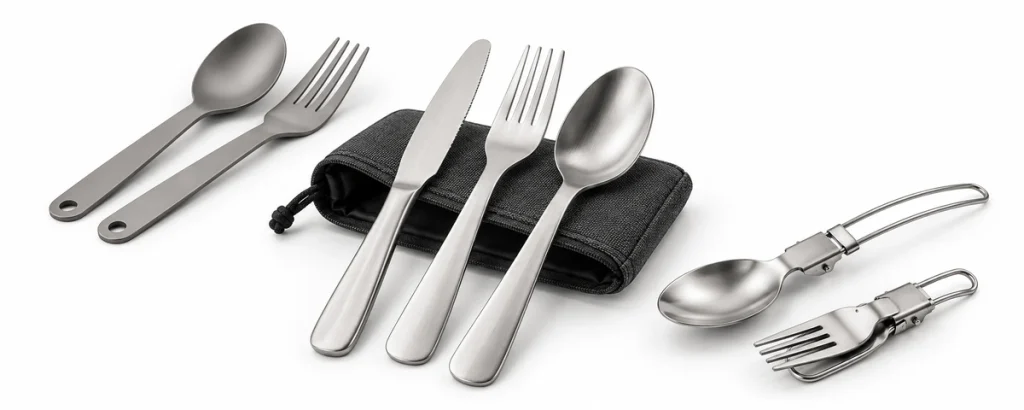
Camping cutlery sets typically include knives, forks, spoons, or sporks designed for outdoor meals. Available in stainless steel, titanium, aluminum, and plastic, these compact eating utensils come in different configurations, including standard, folding, and clip-together designs for camping, hiking, and backpacking.
China offers a wide range of sourcing options for camping cutlery sets within its broader outdoor products supply chain. Buyers can choose from existing designs and explore different materials, set configurations, logo applications, and packaging options, depending on supplier capabilities and order requirements.
This guide covers the key considerations when sourcing camping cutlery sets from China, including product types, material selection, private-label options, and quality control checkpoints to help importers and outdoor brands make informed purchasing decisions.
- What Is Included in a Camping Cutlery Set?
- Materials for Camping Cutlery Sets
- Camping Cutlery Set Specifications
- Wholesale and Custom Camping Cutlery Sets
- Quality Control for Camping Cutlery Sets
- How to Verify Camping Cutlery Set Suppliers in China
- Food Contact Regulations for Camping Cutlery Sets
- Conclusion
- Frequently Asked Questions About Camping Cutlery Sets
- References
What Is Included in a Camping Cutlery Set?
A camping cutlery set is a collection of eating utensils designed for camping, hiking, backpacking, and other outdoor activities. As an essential part of camping equipment, camping cutlery sets complement other outdoor cooking essentials, such as camping pots, camping kettles, and camping grills, to create a complete camp kitchen setup for preparing, cooking, and enjoying meals outdoors.
Camping cutlery sets typically include knives, forks, spoons, or sporks (spoon-fork combinations). Unlike camping cooking utensils, such as spatulas and ladles, camping cutlery is primarily designed for eating rather than food preparation.
The contents vary depending on the intended use. A standard three-piece camping cutlery set includes a knife, fork, and spoon, while compact two-piece sets may combine a fork and spoon or a knife and spork. Family camping cutlery sets provide multiple place settings for group use.
| Set Configuration | Typical Contents |
|---|---|
| 2-Piece Set | Fork + Spoon or Knife + Spork |
| 3-Piece Set | Knife + Fork + Spoon |
| 6-Piece Set | Two sets of Knife + Fork + Spoon |
| 12-Piece Set | Four sets of Knife + Fork + Spoon |
Some sets also include a carabiner, carrying pouch, storage case, or cutlery roll. For wholesale purchasing, the number of utensils, place settings, and included storage accessories should be clearly specified, as configurations vary between suppliers.
Materials for Camping Cutlery Sets
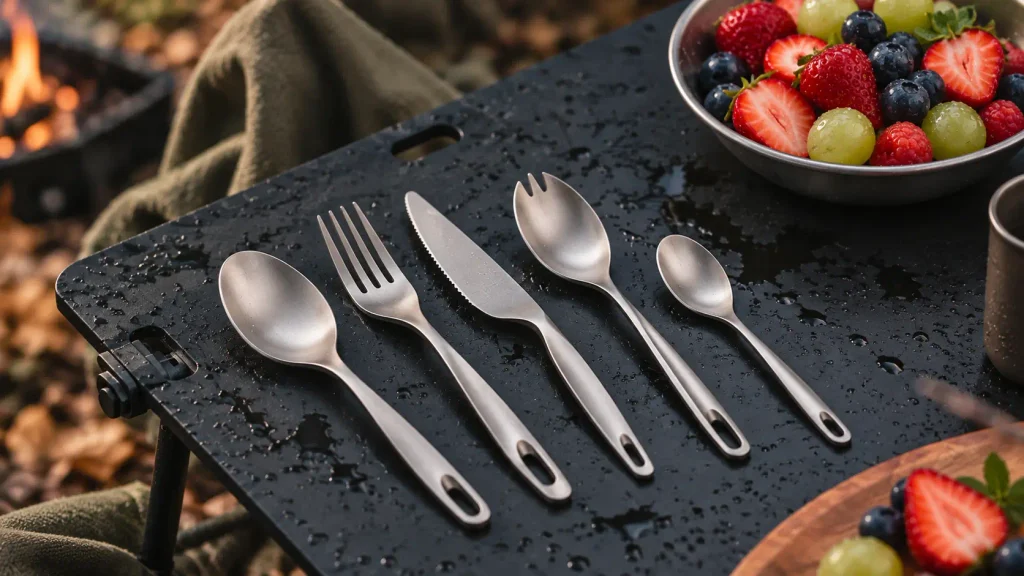
The material used in camping cutlery sets affects product cost, weight, durability, and performance. Even products described as stainless steel cutlery may differ in steel grade, thickness, and surface finish. These differences are important when comparing products and supplier quotations.
| Material | Key Characteristics | Relative Cost | Key Sourcing Risks |
|---|---|---|---|
| Stainless Steel | Durable, corrosion-resistant, and suitable for reusable cutlery | Low to medium, depending on grade and processing | Grade substitution, such as 201 supplied instead of specified 304, insufficient thickness, or inconsistent finishing |
| Titanium | Lightweight, corrosion-resistant, and suitable for weight-conscious outdoor products | Generally high | Unverified titanium grade, material composition, and weight |
| Aluminum | Lightweight, with hard-anodized finishes available for certain designs | Varies by alloy and finishing process | Surface treatment durability, inconsistent finishing, and cleaning restrictions |
| Plastic / Reinforced Polymer | Lightweight and suitable for molded shapes and connected designs | Varies by resin and processing requirements | Unspecified polymer type, heat resistance, and food-contact suitability |
Stainless steel grades such as 201, 304, and 316 are used in various kitchenware and food-contact applications. They differ in chemical composition, corrosion resistance, and cost. Grade 201 is a lower-cost option, but its suitability for eating utensils should be evaluated against the intended use and destination-market requirements, with explicit buyer approval before selection. Grade 304 is widely used in food-contact equipment and utensils, while 316 generally offers better resistance to chloride-related corrosion at a higher cost. However, a stainless steel grade alone does not establish food-contact compliance, and the specified grade should always be confirmed rather than relying solely on a general “stainless steel” description.
For titanium, aluminum, and plastic cutlery, the exact material specifications and applicable surface treatments should also be confirmed, including titanium grade, aluminum alloy and anodizing process, or polymer type.
Because camping cutlery comes into direct contact with food, confirm the exact material, finish, and intended conditions of use before selecting the destination-market testing requirements. A material grade alone is not proof of food-contact compliance; the applicable market rules are covered in the Food Contact Regulations section below.
Camping Cutlery Set Specifications
When sourcing camping cutlery sets from China, clear specifications help buyers compare supplier quotations and avoid differences between approved samples and bulk production.
- Set Contents: Confirm the number of knives, forks, spoons, and sporks. Different configurations can affect quotation comparisons.
- Dimensions: Specify overall length, handle dimensions, and agreed dimensional tolerances.
- Weight: Confirm individual and total set weight, including agreed weight tolerances.
- Packed Size: Record unfolded and packed dimensions, especially for folding cutlery sets.
- Design Features: Specify folding mechanisms, clip connections, or nesting designs.
- Storage Accessories: Confirm whether pouches, cases, or carabiners are included in the quoted price.
- Packaging: Define inner packaging, carton quantities, dimensions, barcodes, and labels.
For family camping cutlery sets, distinguish the number of place settings from the total number of pieces. Clarify whether sporks are counted separately or as part of the fork or spoon quantity.
All agreed specifications should be recorded in the quotation and sample approval documents. Component and accessory quantities should also be listed in packing instructions so they can be checked item by item before shipment.
For a published product example, Sea to Summit’s Frontier UL three-piece set lists a set weight of 26.2 g and a packed size of 16.8 × 4.2 × 2.1 cm. Its knife, fork, and spoon use hard-anodised aluminium. These are brand-published specifications for one design, not an industry standard or JingtuOutdoor test result. When comparing quotations, match material and set contents, confirm whether clips or storage accessories are included in the stated weight, and distinguish packed product dimensions from retail-box or shipping-carton dimensions.
Wholesale and Custom Camping Cutlery Sets
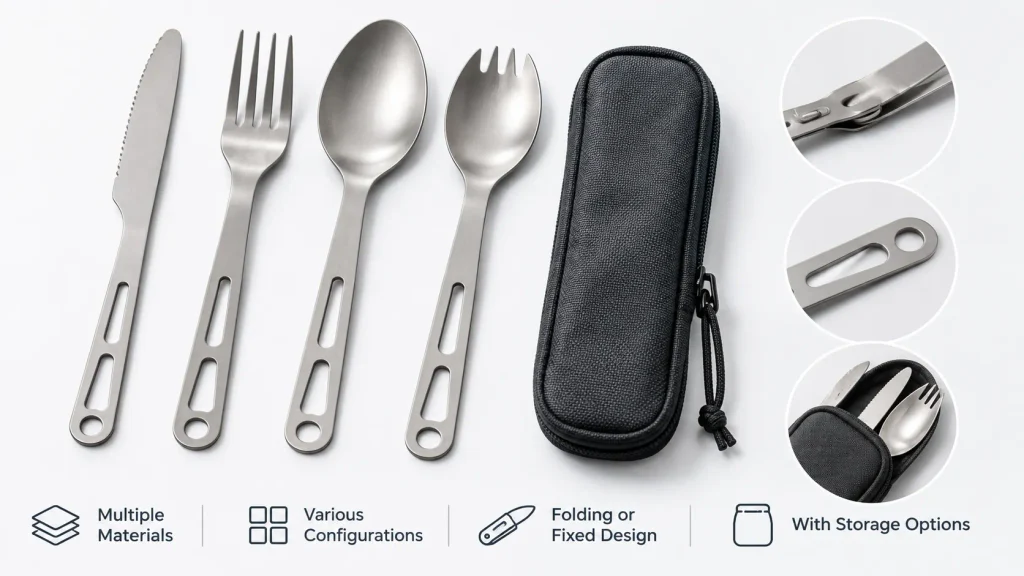
Camping cutlery sets can be purchased wholesale in standard configurations or customized to meet specific requirements.
Using an existing design generally involves lower development costs, while OEM/ODM development allows more control over product appearance and functionality.
In OEM production, the supplier manufactures to the buyer’s design. In ODM, the buyer modifies the supplier’s existing design.
For buyers entering a new market, combining existing utensils with customized packaging can be a simpler starting point.
Common customization options include:
- Logo Customization: The branding methods that work depend on the material and surface finish. Logo position, clarity, and durability should be checked on samples.
- Set Configuration: Knives, forks, spoons, and sporks can be combined into different sets. Changes to standard configurations may affect MOQ and packaging costs.
- Color and Finish: Available colors and finishes depend on the material, the supplier’s capabilities, and the manufacturing process. Some custom finishes may require additional processing and sample approval.
- Storage Accessories: Carrying pouches, cutlery rolls, storage cases, and carabiners can be selected or customized. Fabric type, dimensions, and logo placement should be confirmed.
- Private Label Packaging: Retail boxes, inserts, barcodes, and product labels can be customized. Buyers should provide or confirm barcode data and label content to ensure they meet sales channel requirements.
- OEM/ODM Development: Changes to utensil shapes, handle designs, folding mechanisms, or connection structures may require tooling, prototype development, and additional testing.
For wholesale orders, MOQ, unit pricing, sample costs, and production lead times should be confirmed against the selected configuration.
Multiple customization requirements may affect MOQ, development costs, and production lead times, depending on supplier capabilities and manufacturing processes.
For customized designs, hands-on evaluation is as important as reviewing drawings and specifications.
Buyers can order samples and test them personally. If the project schedule allows, they can also use the samples for an extended period to see how they perform in real conditions.
Handle comfort, balance in use, how easily a folding mechanism operates, and how the set feels to pack and handle every day are all things that may not be apparent from appearance alone.
Before bulk production, buyers should approve samples covering the agreed product configuration, branding, surface finish, and packaging.
If sample testing or user feedback leads to design changes, the impact on cost and delivery schedule should be reviewed, and the changes should be documented and confirmed in writing by both parties.
Quality Control for Camping Cutlery Sets
Material verification is one of the most critical steps in quality control for camping cutlery sets. Buyers should first confirm whether the supplier has an in-house laboratory and the capability to test the specified materials. For example, 201 stainless steel supplied instead of specified 304 may not be identifiable through visual inspection alone.
If the supplier lacks reliable material testing capabilities, buyers should consider arranging testing through a qualified third-party laboratory before shipment. Samples should be drawn from the actual production batch by the buyer or an independent inspector, rather than selected by the supplier. Even when in-house testing is available, buyers should request the test methods and reports and consider independently verifying critical results.
Beyond material verification, the following points should also be checked:
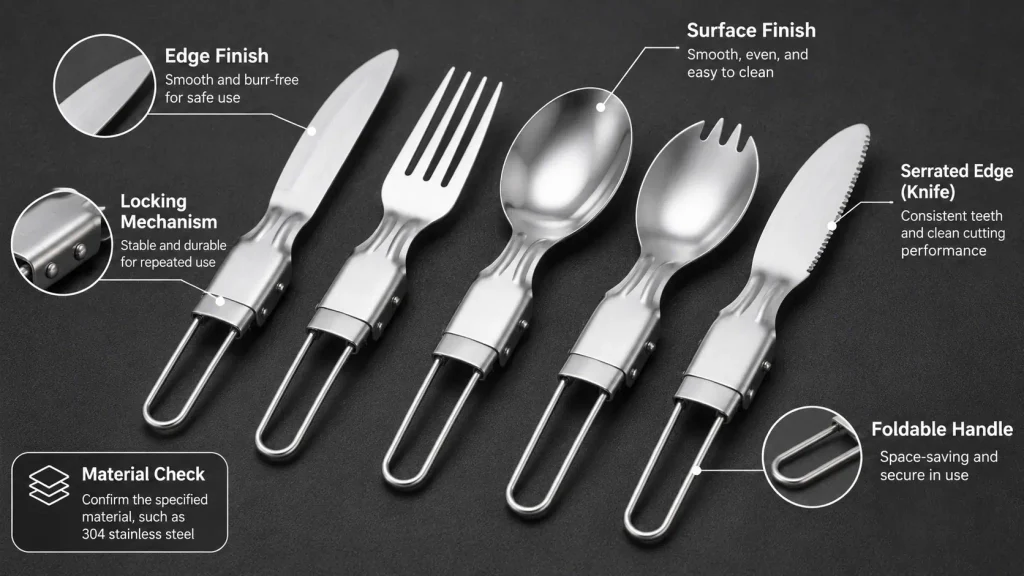
- Edges and Surface Finish: Inspect utensils for burrs, rough polishing, coating defects, and unintended sharp points. Knife edges should match approved samples, without chipped edges or excessive burrs.
- Dimensional Consistency: Check utensil dimensions, thickness, and weight against agreed tolerances and approved samples.
- Functional Performance: Repeatedly operate folding joints, locking mechanisms, and clip connections to check for looseness, sticking, or unreliable locking. Confirm that utensils remain securely folded or connected during storage.
- Food-Contact Compliance: Review applicable test reports and supporting documents for the destination market. Confirm that the documentation covers the actual materials, products, and intended conditions of use.
- Set Completeness: Verify knives, forks, spoons, sporks, small accessories, and storage pouches against the approved configuration. Use packing instructions to check component quantities item by item.
- Packaging and Labeling: Inspect retail packaging, carton quantities, shipping marks, and product labels against order requirements. Barcodes should be scanned to verify readability and data accuracy, rather than relying on visual inspection alone.
Inspection methods, acceptance criteria, and sampling requirements, including applicable Acceptable Quality Limit (AQL) levels, should be agreed upon with suppliers before production and documented in the order or inspection instructions. Approved samples and specification sheets should serve as references during production and pre-shipment inspections.
Even when individual utensils meet quality requirements, a finished set may still be incomplete due to missing accessories or incorrect packing quantities. During packing inspections, selected finished cartons can be opened and their contents checked item by item against the packing list. Component quality and complete-set accuracy should therefore be verified separately.
How to Verify Camping Cutlery Set Suppliers in China
When sourcing camping cutlery sets from China, verifying a supplier’s manufacturing capabilities is essential. Some suppliers manufacture in-house, while others outsource certain processes. The key is understanding who produces the goods and how production is managed.
Key supplier verification points include:
- Manufacturer Identity: Check business registration, registered business scope, factory address, and actual production facilities. Confirm whether the supplier manufactures directly or acts as a trading intermediary. Arrange a factory visit or independent audit where practical.
- Product Specialization: Confirm experience producing similar camping cutlery through production records or previous product samples, rather than catalog images alone.
- Production Equipment: Verify equipment for stamping, forming, polishing, riveting, and assembly. Identify specialized processes handled externally.
- Material Traceability: Check how material grades, purchasing records, and production batches are tracked and linked to finished products.
- Customization Capabilities: Confirm whether the supplier can handle branding, packaging, product modifications, and tooling, including any outsourced work.
- Production Management: Review how production progress, outsourced processes, and potential delays are managed.
- Sample-to-Bulk Consistency: Confirm whether approved samples and bulk orders will be produced at the same facilities using consistent materials and processes. Any changes in production sources should be disclosed and approved.
For multi-piece camping cutlery sets, pouches, packaging, and accessories may come from different suppliers. Buyers should clearly assign responsibility for coordinating these components. When the main cutlery supplier is responsible for delivering the complete set, it should coordinate the accessory suppliers rather than leaving the buyer to manage them separately. Buyers should maintain regular contact with the responsible supplier to track delivery progress and confirm that all components are available and meet the agreed requirements before final assembly and packing.
Ultimately, supplier verification should establish whether the supplier can consistently deliver products to the agreed specifications, not simply offer a competitive price.
Food Contact Regulations for Camping Cutlery Sets
Camping cutlery sets come into direct contact with food, so applicable food-contact regulations must be considered before importing them. Requirements vary by destination market, material, surface treatment, and intended use.
Key regulatory considerations include:
- European Union: Regulation (EC) No 1935/2004 establishes general requirements for food-contact materials, while Regulation (EC) No 2023/2006 covers good manufacturing practice. Plastic cutlery must also meet applicable requirements under Regulation (EU) No 10/2011, including the Declaration of Compliance (DoC) requirements at relevant supply-chain stages.
- United States: FDA food-contact requirements depend on the substances used and their intended conditions of use. Buyers should verify the applicable regulatory basis and examine what any supplier-provided “FDA certificate” actually represents, rather than treating it as proof of finished-product approval.
- United Kingdom: Great Britain applies its own food-contact legislation, including assimilated EU-derived rules, while EU food-contact rules generally apply in Northern Ireland. Buyers should confirm the requirements for the specific destination.
Metal cutlery, including stainless steel products, falls under the EU’s general food-contact framework. As there is no single EU-wide harmonized measure specifically covering metals and alloys, additional national requirements may apply. The EDQM metals and alloys guide provides technical guidance rather than an EU-wide harmonised legal measure. For markets such as Germany, buyers should also confirm any applicable LFGB requirements or customer-specified testing.
Plastic components, coatings, and colorants may be subject to additional restrictions. Buyers should request relevant test reports, material specifications, and compliance documents, ensuring they correspond to the actual product, its intended use, and destination market.
Regulations and technical requirements may change. Buyers should check current official guidance or consult a qualified testing laboratory before placing an order. As discussed in the quality control section, compliance documentation should be verified against the products being supplied, rather than accepted solely on the basis of general supplier declarations.
Conclusion
Sourcing camping cutlery sets from China requires careful consideration of materials, product specifications, customization options, supplier capabilities, and quality control. For custom designs, sample testing and real-world use can help identify potential issues before bulk production, while clear requirements and production coordination help reduce sourcing risks.
JingtuOutdoor helps outdoor brands, importers, and distributors source camping cutlery sets from China. Our sourcing and procurement services cover supplier selection, OEM/ODM customization, sample development, production follow-up, and quality control arrangements. Contact us to discuss your product specifications, order quantities, and sourcing requirements.
Frequently Asked Questions About Camping Cutlery Sets
1. Why do MOQs for similar camping cutlery vary so much between suppliers?
MOQ depends on what is being made, not just the utensil. Stock designs with a simple logo mark are often quoted at lower quantities than a new color, custom packaging or new tooling, which can each carry their own minimums. Ask every supplier to quote MOQ for the exact configuration, logo method and packaging so the figures can be compared fairly.
2. Does the logo marking method depend on the material, and what artwork files are needed?
Yes. The method depends on the material and finish, so ask which options suit each one, such as laser engraving or printing. Prepare vector artwork (AI or PDF) and state the logo size and position. Suppliers may ask for 3D drawings if new tooling is involved. Approve a logo sample before bulk production.
3. How can I verify claims like “BPA-free”, “dishwasher-safe” or “heat-resistant”?
Treat each as a claim that needs evidence. Ask which material it covers and what it was tested on. For plastic cutlery, request the resin type, a heat-resistance limit and a test report for the finished product. Check care claims on a real sample, since wood handles and some finishes may need handwashing. Print only the claims your documents and sample testing support.
4. Do wood or plastic handles and coatings need food-contact documents, or only the steel?
Food-contact requirements are not necessarily limited to the steel. Plastic or wooden components, coatings, and finishes may also need assessment depending on their intended food contact and the destination market. Buyers should request relevant material declarations and supporting documents, and confirm which components and uses they cover.
5. Is there an EU-wide food-contact rule specific to stainless steel cutlery?
Stainless steel cutlery is covered by the EU’s general food-contact requirements under Regulation (EC) No 1935/2004 and good manufacturing practice rules under Regulation (EC) No 2023/2006. There is no specific EU-wide harmonized measure for metals and alloys. National requirements may apply, so buyers should verify the rules in their destination country before ordering.
6. What is the difference between solid titanium and titanium-coated cutlery, and how can I verify it?
Solid titanium cutlery is made from titanium or a specified titanium alloy, while titanium-coated cutlery has a different base material with a surface coating. Buyers should confirm the base material, titanium grade where applicable, and coating specifications. Material declarations and appropriate composition testing provide stronger verification than appearance or weight alone.