
Camping Grills from China: Sourcing & Customization
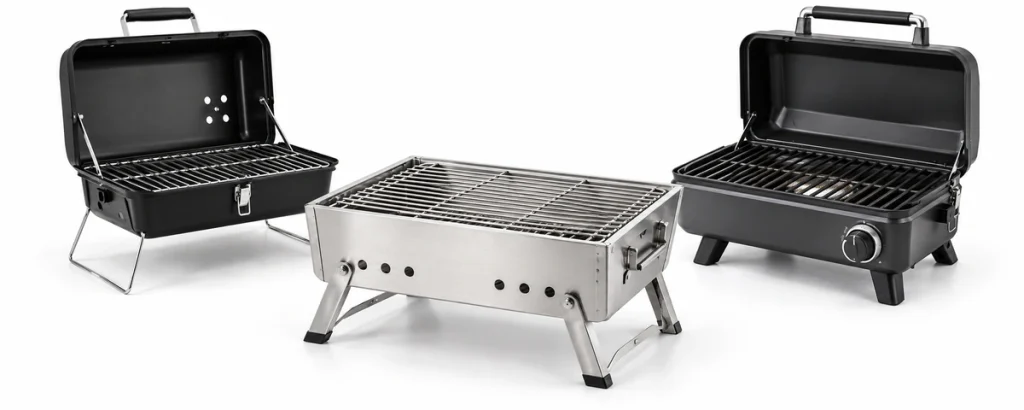
Camping grills are portable outdoor cooking equipment designed for grilling food during camping trips, picnics, and other outdoor activities. Common options include compact charcoal grills, portable gas grills, and folding designs for easier transport and storage. As part of the broader outdoor products range, these grills are designed for camping and other outdoor cooking activities.
China offers sourcing options for camping grills through established metalworking processes, including sheet metal fabrication, stamping, welding, and surface finishing. Buyers can explore existing models with custom branding and packaging or work with suitable suppliers to modify materials, dimensions, and structural features. The available customization options depend on the manufacturer’s capabilities and the product’s technical requirements.
This guide covers the main camping grill types, key specifications, customization options, and quality control considerations to help outdoor brands and importers make informed sourcing decisions in China.
- Types of Camping Grills Available from China
- Camping Grill Materials and Key Specifications
- Camping Grill Customization Options
- How to Evaluate Camping Grill Designs Before Ordering
- Camping Grill Quality Control Checklist
- Safety and Compliance for Camping Grills
- Our Camping Grill Sourcing Process
- Frequently Asked Questions
- References
Types of Camping Grills Available from China
Portable camping grills, also called camping BBQ grills, are part of the broader camping kitchen category. They are primarily distinguished by fuel type, such as charcoal or gas, while folding and tabletop designs describe their structure and portability.
For camping stoves, see our camping stove sourcing guide.
Portable Charcoal Camping Grills
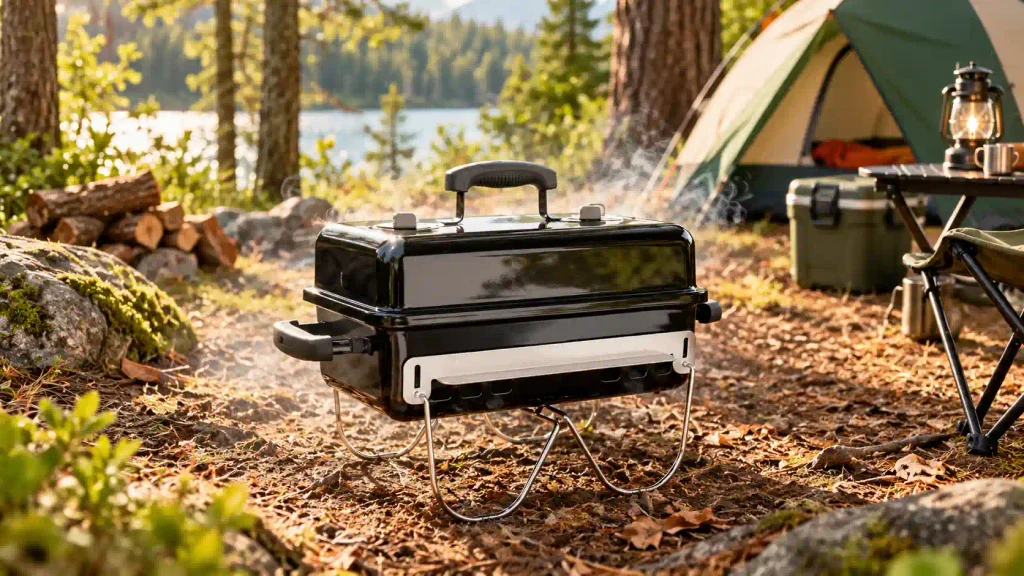
Portable charcoal grills come in compact tabletop and folding designs. Typical components include a steel or stainless steel body, charcoal grate, cooking grate, air vents, and supporting legs. Some models also feature removable ash trays.
Body thickness and ventilation design affect heat performance, while cooking grate materials and leg stability are important when comparing different models.
Portable Gas Camping Grills
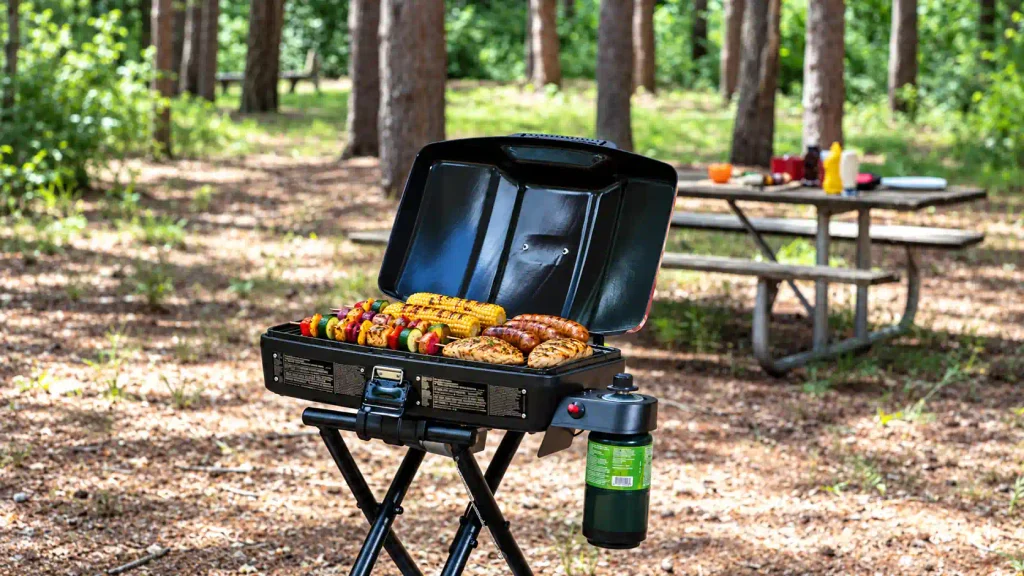
Portable gas camping grills use burners to provide adjustable cooking heat. Common designs include tabletop, suitcase-style, and folding models. A portable propane grill is one option within this gas-fueled category.
Key components include burners, gas valves, regulators, ignition systems, and cooking grates. Gas pressure, cylinder connections, and regulator compatibility must match the destination market. These specifications should be confirmed before sample approval or bulk production.
Folding, Tabletop and Compact Designs
Folding camping grills use collapsible legs or panels to reduce storage space, while tabletop models are designed for use on suitable outdoor surfaces. Compact designs prioritize smaller dimensions and easier transport. These features can apply to both charcoal and gas grills.
Folding mechanisms and leg locks affect structural reliability. For tabletop models, underside heat exposure and stability require attention, as smaller dimensions do not necessarily mean safer operation.
Camping Grill Materials and Key Specifications
Material selection and product specifications affect the weight, durability, heat resistance, and manufacturing cost of portable camping grills. Comparing the same specifications across suppliers helps buyers identify differences that may not be obvious from product photos or quotations.
Grill Body and Cooking Grate Materials
Camping grill bodies commonly use carbon steel or stainless steel. Carbon steel typically relies on protective coatings or porcelain enamel for corrosion resistance, while stainless steel offers varying corrosion resistance depending on its grade. Surface finishes should also withstand the intended cooking temperatures, so coating specifications and temperature suitability need to be verified.
Cooking grates can be made from stainless steel, plated steel, porcelain-enameled steel, or cast iron. Specifications should identify the material grade, surface finish, grate construction, and wire or rod diameter, as these differences affect product quality and pricing.
Cooking Area, Weight and Packed Dimensions
Cooking area, overall dimensions, and weight affect both cooking capacity and portability. Suppliers should use a consistent method to measure cooking area, while folding models need both assembled and packed dimensions.
When comparing quotations for wholesale camping grills, request cooking area, body thickness, grate dimensions, net and gross weight, packed size, and outer carton dimensions. These details also help estimate packaging and shipping requirements.
Fuel Systems and Heat Control
Charcoal camping grills regulate heat mainly through airflow, using vents and dampers. Charcoal grate placement and ash collection design also affect airflow and cleaning.
Gas or propane camping grills use burners, valves, and regulators to control fuel delivery and heat output. Key specifications include fuel type, rated heat input (such as kW or BTU/h), gas consumption, operating pressure, and connection type. Operating pressure and fuel connections must be checked against the destination market’s requirements before the design is finalized.
Sample RFQ Specification Sheet: Portable Folding Charcoal Grill
The following example shows how buyers can organize specifications for a portable charcoal grill when requesting quotations. Gas or propane models require additional details, including rated heat input, operating pressure, and fuel connection type.
| Specification | Example Entry |
|---|---|
| Grill type | Portable folding charcoal grill |
| Body material | Carbon steel (supplier to state grade) |
| Body thickness | 0.8 mm (specify per part if different) |
| Surface finish | Heat-resistant coating (supplier to confirm type and suitable service temperature) |
| Cooking grate | Stainless steel (supplier to state grade), 3 mm rod diameter |
| Cooking area | 40 × 25 cm (grate surface) |
| Assembled dimensions (L × W × H) | 45 × 30 × 28 cm |
| Packed dimensions (L × W × H) | 45 × 30 × 8 cm |
| Net / gross weight | 3.5 kg / 4.2 kg |
| Fuel | Charcoal |
| Packaging | Individual carton; master carton quantity to be specified |
| Outer carton dimensions | Supplier to specify |
| Target market and labeling | Buyer to specify; warning labels and manual language to match |
| Target quantity | Buyer to specify |
Illustrative format only. These figures are not typical or recommended specifications and do not represent a verified product. Final materials, dimensions, weight, and coating suitability must be confirmed with the supplier.
Camping Grill Customization Options
Camping grill customization falls into three levels: private labeling, modifications to existing models, and new product development. The buyer’s requirements determine the level, and the level determines tooling needs, testing requirements, and sample approval procedures.
Logo, Packaging and Private Label
Existing models can be customized with logos, colors, packaging, manuals, and accessories as part of private label sourcing. Logo methods should suit the grill’s surface finish and be checked on samples, while warning labels must match the fuel type and destination market.
Materials, Dimensions and Structural Changes
Changes to body thickness, cooking grates, ventilation, or folding legs can affect heat performance and stability. Burners, valves, and regulators on gas or propane grills are safety-related components, so any change should be reassessed against the target market’s requirements. Buyers should confirm whether existing test reports cover the revised design before approving updated drawings and samples.
New Product Development
New camping grill development should begin with a feasibility check during supplier selection, so buyers can assess whether a supplier can manufacture the proposed design and estimate development costs before committing a significant budget. Once the buyer and supplier agree that the concept is technically feasible, development proceeds through technical drawings, prototypes, performance testing, sample approval, and production release. Tooling costs and ownership, along with target-market requirements, should be clarified before full development begins, particularly for gas or propane grills.
How to Evaluate Camping Grill Designs Before Ordering
Evaluating camping grill designs requires understanding how different products are used, not just comparing specifications. Buyers need to balance portability, cooking convenience, durability, and cost based on their customers’ actual needs.
Balancing Portability, Weight and Durability
Lighter grills are easier to transport, but reducing material can involve trade-offs in structure and cooking capacity. Folding designs save storage space but introduce moving parts that need reliable construction.
Published products illustrate different approaches. On the charcoal Weber Go-Anywhere, the legs lock the lid in place, while the propane Coleman RoadTrip 285 uses quick-fold legs and wheels. Consider whether customers will use the grill for car camping, short-distance carrying, or regular campsite cooking.
Comparing Cooking Performance and Ease of Use
Grill designs differ in heat control, fuel handling, and cleanup. The Coleman RoadTrip 285 has three independently adjustable burners, while the Napoleon TravelQ 240 uses one large burner. For charcoal cooking, the Go-Anywhere’s two-piece grate allows charcoal to be added during use, while the Weber Smokey Joe 14″ includes an ash catcher.
For example, Coleman lists a 285 sq. in. cooking area and up to 20,000 BTUs for the RoadTrip 285, while Napoleon lists 240 sq. in. and 9,000 BTUs for the TravelQ 240. These are model-specific examples, not sourcing requirements. Compare rated input alongside cooking area, portability, and sample cooking performance rather than treating higher output as automatically better.
These configurations serve different needs rather than indicating which grill is better. Physical samples and cooking trials help reveal differences beyond published specifications.
Matching Features and Cost to Your Customers
Cooking grates, folding stands, wheels, accessories, and packaging choices affect product cost and convenience. For example, Coleman and Napoleon specify porcelain-coated cast iron cooking grates, while the Weber Smokey Joe uses a plated-steel grate.
Before finalizing a design, identify which features customers need and compare supplier quotations to understand the cost of each configuration.
Product details are based on manufacturers’ published specifications and may vary by market.
Camping Grill Quality Control Checklist
Overseas buyers cannot monitor every production process on-site. Camping grill quality control should therefore focus on key production stages, using approved samples, agreed specifications, and inspection records to manage quality remotely.
Quality Checks at Different Production Stages
| Inspection Stage | Key Checks | Buyer Verification |
|---|---|---|
| Before production | Steel grade, body thickness, cooking grate and coating specifications, packaging and label artwork | Approve samples, specifications, material records, and artwork |
| Initial production | Welding, assembly, folding legs and component fit | Review first-article inspection reports and photos |
| During production | Material consistency, coating defects and assembly quality | Request in-process QC reports or third-party inspection |
| Functional and performance testing | Heat deformation, grate stability, charcoal airflow; for gas grills, burner operation, ignition and leak checks | Review test results against agreed criteria |
| Before shipment | Dimensions, accessories, packaging, labels and carton markings | Arrange sampling inspection before shipment |
Managing Quality Without Being On-Site
Manufacturers handle routine checks, while buyers should agree on inspection responsibilities and obtain evidence at critical stages. Material changes, outsourced coating, or assembly variations can cause differences between approved samples and mass production.
Agree on sampling and acceptance criteria in advance. Record defects, arrange corrective action, and re-inspect affected goods before shipment release. For gas or propane grills, factory QC cannot replace applicable safety testing and regulatory compliance assessments.
Safety and Compliance for Camping Grills
Camping grill safety requirements depend on fuel type, product design, and destination market. Buyers should confirm applicable regulations and testing requirements before approving samples or finalizing the design.
Charcoal Grill Safety Requirements
Charcoal grills involve risks from hot surfaces, fire, and carbon monoxide. Instructions must warn against use inside tents, vehicles, or enclosed spaces.
For European markets, EN 1860-1:2024 covers solid-fuel barbecue construction, testing, markings, and instructions. EU consumer product safety obligations under Regulation (EU) 2023/988 also apply, including requirements for an EU-based responsible economic operator.
Gas and Propane Grill Compliance
Gas grills require checks for fuel compatibility, operating pressure, ignition, and leakage. In the EU, Regulation (EU) 2016/426 covers gas cooking appliances and requires third-party conformity assessment, with the applicable route confirmed for each model.
CSA/ANSI Z21.58 / CSA 1.6 is relevant to outdoor cooking gas appliances in the US and Canada. Australia has its own gas appliance certification requirements, while Great Britain recognises applicable CE and UKCA routes.
Documentation and Market Requirements
Before production, confirm that certificates and test reports cover the exact model, fuel configuration, destination, and applicable standard edition. Check instructions, warning labels, and required conformity documents.
Existing supplier certificates do not automatically cover modified designs or additional markets. Confirm the applicable requirements with a qualified testing or certification body.
Our Camping Grill Sourcing Process
JingtuOutdoor coordinates camping grill sourcing as a single project, from requirements to shipment, through our China sourcing services.
Step 1 – Requirements: Confirm grill type, fuel configuration, specifications, customization needs, order quantity, and destination market.
Step 2 – Sourcing and Sampling: Review camping grill suppliers’ manufacturing capabilities and test documentation, compare quotations against the same specification sheet, and coordinate samples for buyer approval.
Step 3 – Production and QC: Follow production against the approved sample, document agreed changes, and coordinate inspections at key quality checkpoints.
Step 4 – Shipping: Verify packaging, labels, shipping documents, and logistics arrangements before dispatch.
To start a project, share your grill type, target quantity, and destination market through our inquiry form below.
Frequently Asked Questions
1. What is the minimum order quantity for custom camping grills?
There is no fixed MOQ for every camping grill configuration. Buyers should request separate quotations for standard models, custom finishes, structural modifications, and printed packaging. Confirm whether MOQ applies per model, color, or packaging design, and whether smaller trial orders involve additional charges.
2. What should a camping grill sample and tooling quotation include?
A quotation should separate sample fees, revisions, tooling, testing, and shipping costs. For modified grill bodies, folding mechanisms, or handles, clarify which tools or fixtures are required. Tooling ownership, storage, maintenance, transfer conditions, and any sample-fee deductions should be agreed upon before development.
3. Does the quoted lead time include grill development and testing?
Not necessarily. Buyers should request separate timelines for prototype development, revisions, testing, packaging approval, and mass production. Confirm when the production lead time begins, including any deposit, sample approval, or component availability requirements. Shipping transit time should be stated separately.
4. Will existing test reports cover my customized camping grill?
Not automatically. Changes to materials, coatings, structures, or gas components can affect whether existing reports remain applicable. Compare the proposed design with the tested configuration and obtain written confirmation from the relevant testing or certification body before relying on the original documents.
5. Can the same gas camping grill be sold in different countries?
Not necessarily. Gas type, operating pressure, cylinder connections, and regulator requirements can differ between markets. Confirm the intended destination and compatible fuel-system configuration, along with the required labels, instructions, and conformity documentation. A connector adapter alone does not establish compliance.
6. What should be included in a camping grill packing specification?
Specify the complete product set, including cooking grates, ash or grease trays, folding parts, fasteners, instructions, and applicable accessories. Confirm protective packaging, packed dimensions, and gross weight. State whether fuel or gas cylinders are included, and verify shipping requirements with the freight forwarder.
References
- Weber. Go-Anywhere Charcoal Grill – Official Product Specifications. Product design, cooking grate and portability features.
- Weber. Smokey Joe 14″ Charcoal Grill – Official Product Specifications. Cooking grate materials, airflow and ash collection.
- Coleman. RoadTrip 285 Portable Stand-Up Propane Grill. Folding structure, burner configuration and cooking features.
- Napoleon. TravelQ 240 Portable Gas Grill. Portable gas grill design and components.
- British Standards Institution (BSI). BS EN 1860-1:2024 – Barbecues Burning Solid Fuels. Requirements and test methods for solid-fuel barbecues.
- European Commission. Gas Appliances Regulation (EU) 2016/426. Gas appliance safety and conformity assessment.
- European Union. Regulation (EU) 2023/988 – General Product Safety Regulation. Consumer product safety and economic operator obligations.
- UK Government. Gas Appliances Regulations – Great Britain. Gas appliance requirements and CE/UKCA marking.
- Energy Safe Victoria. Gas Appliances – Online Sales. Australian gas appliance certification and compliance marking.
- U.S. Consumer Product Safety Commission (CPSC). CPSC Warns – Never Use Charcoal Grills Indoors. Carbon monoxide hazards associated with charcoal grills.