
Camping Kettle Sourcing from China
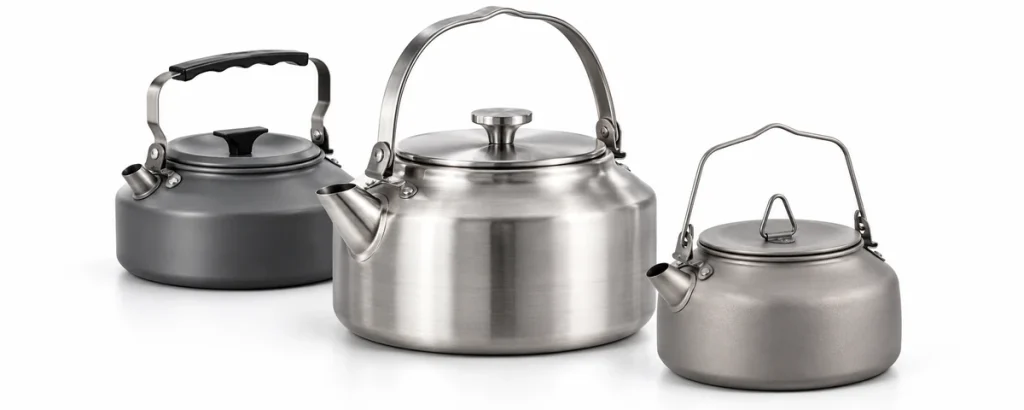
Camping kettles are designed for boiling water outdoors, whether for tea, coffee or meal preparation. As part of a broader camping cookware range, they support different camping kitchen setups and complement other outdoor products, giving brands and importers options for different capacities, heat sources and packing requirements.
When sourcing from China, buyers need to look beyond the kettle’s appearance and material name. Body construction, surface finish, handle design and heat-source compatibility should be clearly specified so suppliers can quote against the same requirements.
This guide to camping kettle sourcing from China helps you compare product types and materials, evaluate suppliers and prepare a purchasing brief—from capacity and packed dimensions to sample checks, branding and packaging.
- Types of Camping Kettles
- How Do Materials Affect Camping Kettle Performance?
- How Do You Choose the Right Camping Kettle Capacity, Weight and Packed Size?
- How Do Handle, Lid and Spout Designs Affect Safety and Usability?
- Which Heat Sources Are Camping Kettles Compatible With?
- What Should You Include in a Camping Kettle RFQ?
- How to Evaluate Camping Kettle Suppliers in China for OEM & Private Label
- How to Inspect Camping Kettle Quality Before Shipment
- Conclusion
- FAQs
Types of Camping Kettles
Camping kettles come in different designs and configurations for various camping activities. These categories often overlap—a backpacking kettle may also be collapsible, while a traditional metal kettle may be suitable for campfire use. For brands and importers, choosing the right products starts with understanding how consumers in their target markets use them.
Traditional Camping Kettles
Traditional camping tea kettles typically feature a metal body, pouring spout and fixed or folding handle. Commonly used with portable camping stoves, they vary in capacity, material and handle design.
Backpacking Kettles
Designed for lightweight travel, these kettles often use aluminum or titanium with folding handles. Weight, packed size and stove stability are key considerations.
Collapsible Camping Kettles
These kettles use flexible silicone sections and a rigid base to save storage space. Buyers should check folding durability, material specifications and heat-source compatibility.
Campfire Kettles and Billy Teapots
Campfire kettles are designed for open-fire use, while billy teapots are commonly used for boiling water and making tea outdoors. Some models feature a bail handle for hanging above a fire. Buyers should verify heat-source compatibility and handle safety.
Whistling Camping Kettles
These kettles feature a whistle that signals boiling. This function can also be found on traditional or campfire-compatible models. Buyers should check whistle operation and pouring safety.
How Do Materials Affect Camping Kettle Performance?
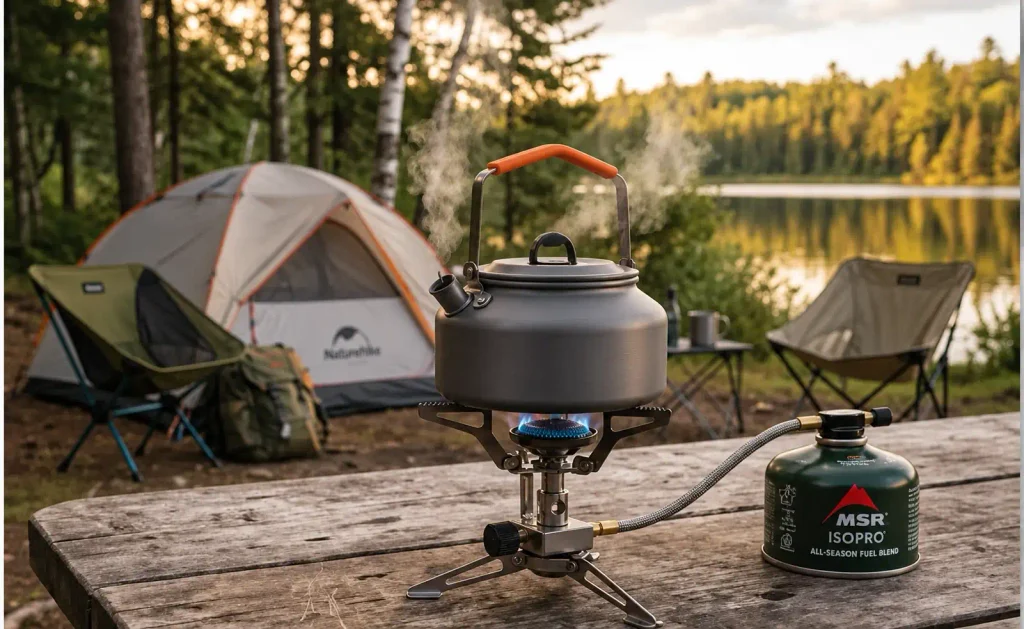
Choosing camping kettle materials starts with understanding demand in the target market. Brands and importers can review sales trends, customer preferences and price segments to decide which materials to offer. Rather than relying on a single option, a product range may combine aluminum and stainless steel models with premium titanium kettles, depending on market demand and positioning.
- Stainless Steel Camping Kettles: Durable and corrosion-resistant, suitable for general camping use. Key specifications include steel grade, body thickness and base construction, particularly when induction compatibility is required.
- Aluminum Camping Kettles: Lightweight with good heat conductivity, making them a practical option for backpacking and portable stove use. Hard-anodized finishes are also available, offering a more wear-resistant surface than untreated aluminum.
- Titanium Camping Kettles: Lightweight and corrosion-resistant, often positioned in the premium backpacking segment. Their higher material cost makes them more suitable for product ranges targeting customers who value low weight and are willing to pay more.
- Silicone Collapsible Kettles: Flexible silicone walls and a rigid heating base reduce packed size, appealing to campers with limited storage space. Heat-source compatibility and folding durability depend on the specific design.
Material choice is only one part of product selection. Capacity, kettle construction and intended use also influence how different models fit into a camping product range. Buyers building a broader camp kitchen range can also source camping cutlery sets alongside kettles, confirming utensil quantities and storage accessories separately.
How Do You Choose the Right Camping Kettle Capacity, Weight and Packed Size?
For buyers, camping kettle capacity and weight should align with target-market demand and brand positioning. A lightweight backpacking brand may focus on compact 1 litre models, while a family camping range may prioritize larger capacities. Reviewing competitor product ranges, customer preferences and sales data helps buyers decide which specifications fit their market position.
- Capacity: A 1 litre camping kettle may suit solo campers and backpackers, while 1.5–2 litre models can serve couples and family campers. Buyers can select a mix of capacities based on their target customers rather than offering every available size.
- Weight: Two kettles with the same capacity and material can still differ in weight because of body thickness, base construction, handles and lids. Comparing actual product weights helps buyers identify whether a lighter design supports their product positioning without compromising the intended use.
- Packed Size: Folding handles, compact profiles and nesting designs can help kettles fit into camping cookware sets. Smaller packed dimensions may also reduce packaging volume and improve shipping efficiency.
When comparing suppliers, buyers should confirm actual water capacity, product weight and packed dimensions. These specifications help ensure quotations and samples are evaluated on a consistent basis.
Named product examples: The following brand-published specifications illustrate how capacity, weight and storage requirements can differ. They are individual product examples, not industry standards or JingtuOutdoor sample measurements.
| Product | Capacity and Weight | Dimensions and Storage Notes |
|---|---|---|
| Trangia Kettle 245 (BF200245) | 1.4 L; listed weight 201 g | Listed product dimensions: Ø152 × 106 mm. Trangia states that it cannot be packed inside the 25 Large or 27 Small stove; these are not retail-packaging dimensions. |
| Sea to Summit Detour Stainless Steel Collapsible Kettle | 1.6 L; listed packed weight 435.9 g | Technical specification table: packed size 18 × 17 × 5.8 cm; expanded dimensions 17 × 17 × 15.1 cm. |
Specifications checked on 19 October 2026. Sea to Summit also describes a collapsed height of 63 mm in its feature text, which differs from the 5.8 cm height in its technical table. The figures above follow that table; confirm the current drawing or sample dimensions before using them for packaging calculations. When comparing suppliers, keep product weight, packed weight, product dimensions and retail-packaging dimensions separate.
How Do Handle, Lid and Spout Designs Affect Safety and Usability?
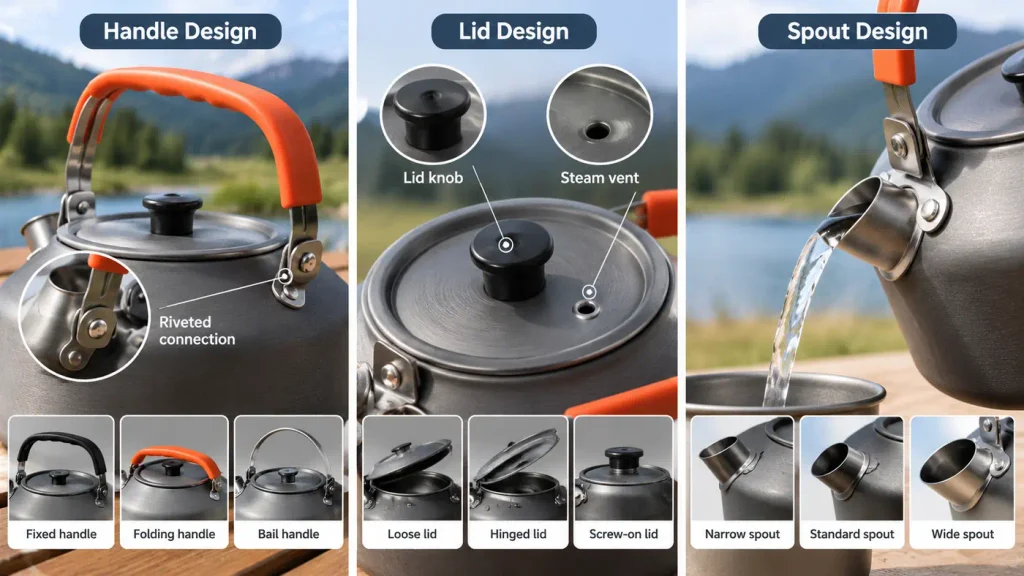
Before finalizing a camping kettle design, buyers can ask suppliers to provide samples with different handle, lid and spout configurations. Comparing these options under the intended conditions of use helps identify which designs offer better safety, usability and alignment with the target customers’ needs.
- Handle Design: Fixed, folding and bail handles offer different handling and storage options. Compare their stability when lifting a filled kettle, grip comfort and exposure to heat. For folding handles, check whether the joint remains secure after repeated use. Riveted and welded connections should also be evaluated for strength and stability.
- Lid Design: Compare how securely different lids remain in place during pouring and how easily they can be opened for filling. Lid knobs and steam vent positions also matter, as hot surfaces or escaping steam may create burn risks.
- Spout Design: Different spout shapes can affect pouring control, dripping and splashing. Testing samples at different water levels helps determine which design provides a more controlled and consistent flow.
These comparisons help buyers select a design that supports their product positioning rather than relying on appearance alone. Once a design is selected, the handle attachment, lid retention and spout requirements can be documented for consistent supplier quotations and production.
Which Heat Sources Are Camping Kettles Compatible With?
Heat-source compatibility varies across camping kettle designs, so buyers should match it to how their target customers actually cook outdoors. For example, Trangia describes its aluminum Kettle 245 as suitable for open-flame use, with a wire handle and removable plastic handle cover. The manufacturer cautions that plastic parts, including the lid knob and handle cover, require care around high heat and open flames. Sea to Summit’s Detour collapsible kettle works on gas stoves and many induction cooktops; its instructions require the flame pattern to stay within the printed ring on the base and the handles to remain upright.
- Portable Camping Stoves: Gas, liquid-fuel and alcohol stoves differ in burner design and heat output. Check stability on the stove supports, base dimensions and flame exposure. Oversized cookware can reflect heat toward the fuel canister and create overheating risks on certain stove setups.
- Campfire Use: Check how handles are attached, whether the bail handle can safely support the filled kettle when suspended, and the heat resistance of grips and lid knobs. Evaluate surface finishes for discoloration or damage under the intended conditions.
- Collapsible Kettles: Request the supplier’s temperature limits, heating-base construction details and usage restrictions. Direct flame contact with silicone walls can damage them, even when the metal base is suitable for heating.
- Induction Cooking: Compatibility depends on the base construction, not the body material alone. Conventional titanium and aluminum kettles require a suitable magnetic base layer, while stainless steel compatibility depends on its magnetic properties and construction. Confirm performance on the intended induction cooktop.
Do not accept claims such as “suitable for all camping stoves” without documented usage conditions. Before confirming an order, request written heat-source limitations and evaluate samples under their intended operating conditions. Overheating and dry-boil risks should be addressed through appropriate safety information and, where necessary, controlled testing.
JingtuOutdoor can help coordinate supplier documentation and sample evaluations to support accurate product specifications and usage instructions.
What Should You Include in a Camping Kettle RFQ?
To compare camping kettle quotations fairly, send the same RFQ (Request for Quotation) and specification sheet to multiple suppliers. Each supplier should indicate whether each requirement is met or whether an alternative solution is proposed. Any deviations must be clearly identified, including the actual specifications and their impact on pricing. Safety and applicable compliance requirements must still be met.
| RFQ Item | What to Include | Why It Matters |
|---|---|---|
| Intended Use & Reference Product | Target customers, camping activities, reference photos, product links, drawings or physical samples | Establishes the intended product and whether an existing design or modification is required |
| Material & Construction | Material grade, body thickness, base construction and key structural requirements | Wall thickness and base construction affect material consumption and manufacturing costs |
| Capacity & Dimensions | Nominal and usable capacity, target weight, packed dimensions and acceptable tolerances | Prevents quotations based on different capacities, weights or product sizes |
| Heat Source Compatibility | Required stove types, operating conditions and supplier-stated usage limits | Confirms whether the proposed kettle supports the intended heating methods |
| Component Design | Handle attachments, lid retention, spout design, optional features and folding mechanisms where applicable | Structural differences may affect functionality, tooling requirements and production costs |
| Surface Finish & Compliance | Coatings, anodizing, destination markets, applicable food-contact requirements and supporting evidence | Connects finishing specifications and compliance requirements to the intended sales market |
| Branding & Packaging | Logo artwork and application method, retail packaging, labels, barcodes and carton specifications | Accounts for customization, packaging materials and related production charges |
For buyers sourcing wholesale camping kettles, the RFQ should also cover pricing and additional charges (including tooling, samples and logo costs), order and delivery terms (MOQ, Incoterms, payment terms and lead time), sample and QC requirements (such as boiling performance, handle temperature and lid retention), and supporting documents (material specifications and relevant test reports). These details help buyers compare the full quotation rather than the unit price alone.
Have a camping kettle specification or supplier quotation? Send us your requirements, and we can help you review the specifications and coordinate sourcing options in China.
How to Evaluate Camping Kettle Suppliers in China for OEM & Private Label
Match Supplier Manufacturing Capabilities to Your Product Requirements
When evaluating a camping kettle manufacturer in China, buyers should verify that its production capabilities match their product requirements. For example, a factory specializing in stainless steel kettles may not have the equipment or experience needed to produce titanium or silicone collapsible models.
Different kettle types require different manufacturing processes:
| Kettle Type | Key Manufacturing Processes | What to Verify |
|---|---|---|
| Stainless Steel | Metal forming, joining, polishing and handle assembly | Relevant production experience and in-house processes |
| Titanium | Titanium forming, joining and finishing | Titanium manufacturing experience and sample quality |
| Aluminum | Metal forming, anodizing or coating | Surface treatment capabilities and quality control |
| Silicone Collapsible | Silicone molding and metal-base integration | Connection durability and temperature limits |
Whenever possible, visit the factory to verify its actual manufacturing capabilities. Inspect production equipment, ongoing operations, workshop cleanliness and material storage rather than relying solely on brochures or capacity claims. Identify which processes are performed in-house, which are outsourced and how subcontracted work is controlled. If a visit is not practical, consider a live video inspection or an independent factory audit.
Supplier capabilities should also align with your brand positioning and product development plans. Review existing kettle models to determine whether their materials, designs and specifications meet your requirements. Suitable existing products can simplify private label customization, while more extensive OEM/ODM development may require additional technical expertise, tooling and development costs.
How to Inspect Camping Kettle Quality Before Shipment
Before approving shipment, camping kettles should be inspected against the approved sample and agreed product specifications. Key inspection points include:
- Check the kettle body, seams and spout for water leakage.
- Verify handle strength and secure attachment.
- Check lid fit, retention and pouring performance.
- Confirm the base is flat and stable.
- Inspect surfaces for scratches, dents, sharp edges and coating defects.
- Check folding mechanisms, silicone connections or whistle functions where applicable.
- Verify product dimensions, capacity and weight.
- Confirm logos, labels and packaging meet approved requirements.
- Review relevant material and food-contact compliance documents.
For large-volume orders, consider arranging an independent third-party pre-shipment inspection rather than relying solely on the factory’s internal quality checks. Inspection should follow an agreed sampling plan, with any defects documented and corrective actions completed before shipment approval.
Conclusion
Sourcing camping kettles from China involves more than comparing prices. Buyers need to select suitable materials and designs, define clear specifications, evaluate supplier capabilities and verify product quality before shipment. These steps help reduce sourcing risks and support successful private label and OEM/ODM projects.
JingtuOutdoor helps outdoor brands and importers find suitable Chinese suppliers, coordinate product customization, manage sampling and follow up on production and quality inspections. If you are planning to source camping kettles from China, contact us to discuss your product requirements.
FAQ
What is the best material for a camping kettle?
There is no single best material for every camping kettle. Stainless steel, aluminum and titanium offer different trade-offs in weight, durability and cost. The right choice depends on your target customers and intended use. See our material comparison.
How do I find reliable camping kettle suppliers in China?
Reliable sourcing starts with matching a supplier’s manufacturing experience to your product requirements. Production capabilities, sample quality, outsourced processes and customization options should all be evaluated. See how to evaluate camping kettle suppliers.
What is the MOQ for custom camping kettles in China?
Existing kettle models with simple branding may offer more flexible minimum order quantities than fully customized designs. MOQ should be confirmed by model, color and customization requirements. These details can be included in your camping kettle RFQ.
What is the difference between private label and OEM camping kettles?
Private label typically involves adding a brand’s logo or packaging to an existing kettle design. OEM manufacturing generally follows buyer-defined specifications and may involve changes to materials, dimensions or components. More extensive customization can require additional sampling, engineering or tooling.
Who owns the molds for custom camping kettles?
Mold ownership is not automatically determined by who pays the tooling fee. Before payment, buyers and suppliers should agree in writing on ownership, storage, maintenance, permitted use and transfer arrangements. Legal advice may be appropriate for significant tooling investments.
What food-contact compliance requirements apply to camping kettles?
Requirements depend on the destination market, materials and intended use. US FDA food-contact requirements and EU food-contact legislation, including Regulation (EC) No 1935/2004, are relevant, while Canada and Australia have their own requirements. Regulations set legal requirements; declarations of compliance, where required, and third-party test reports provide different forms of supporting evidence. These documents should match the materials and intended use, rather than being treated as a universal FDA or EU certification certificate for every camping kettle.
References
- Trangia — Kettle 245, 1.4 L: Product dimensions, weight, storage limitations and open-flame precautions.
- Sea to Summit — Detour Stainless Steel Collapsible Kettle: Capacity, packed weight, dimensions and stove-use instructions.
- U.S. FDA — Food-Contact Substances: Official explanation of how substances that contact food are regulated.
- European Commission — Food Contact Materials Legislation: EU framework, manufacturing requirements and material-specific legislation.