
Tent Cot Sourcing from China
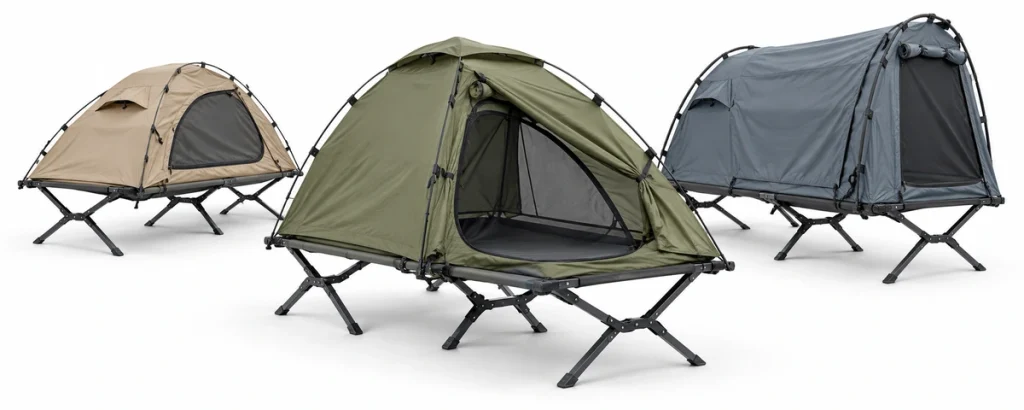
Tent cots combine an elevated sleeping platform with a tent shelter, providing an off-the-ground sleeping option for camping and other outdoor activities. As a specialized type of camping cot, they include both a supporting frame and a tent enclosure, often with mesh panels and a rainfly.
Sourcing tent cots from China involves coordinating metal frames, sewn tent fabrics, connecting components, and final assembly. Tent cot manufacturers may offer different designs and customization options, but buyers need to confirm how these components are manufactured, fitted, and checked as a complete product.
This guide covers the key considerations when sourcing tent cots from China, including product types, frame and shelter construction, buyer specifications, product development, final inspection, and packaging. It focuses on checking the tent cot as a complete system, so buyers can identify fit, assembly, and quality issues before approving samples or arranging shipment.
What Is a Tent Cot?
A tent cot, also known as a cot tent, is an elevated camping bed combined with a tent shelter. It keeps the sleeping platform above the ground while providing an enclosed space for protection from insects and exposure to the elements. Tent cots are a specialized category of outdoor products designed for camping and other outdoor activities.
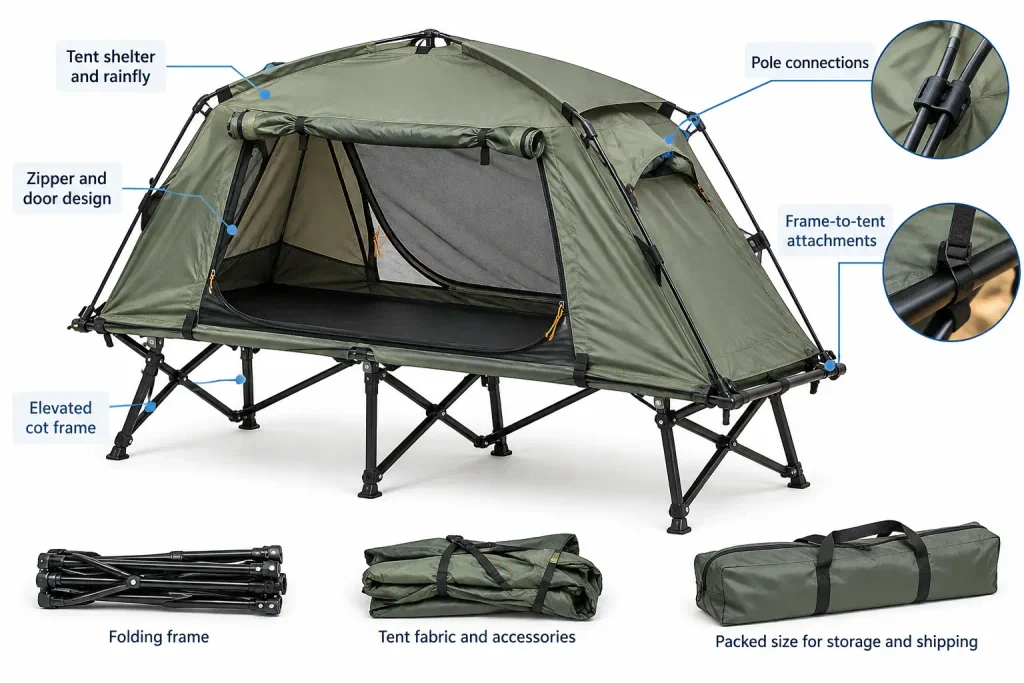
A typical tent cot consists of three main parts:
- Cot frame and sleeping platform: A folding metal frame supports the sleeping surface above the ground.
- Tent body and shelter: Fabric panels, mesh windows, and a rainfly provide enclosure, ventilation, and weather protection.
- Connection system: Poles, straps, clips, or other attachment points secure the tent body to the cot frame.
Unlike a standard camping cot, a tent cot must function as a complete sleeping system. The frame needs to support the intended load, while the shelter must fit securely without interfering with assembly, folding, or normal use.
For buyers, the key distinction is that a reliable cot frame and a well-made tent do not automatically guarantee a reliable tent cot. The connections, component compatibility, and performance of the assembled product also need to be verified.
Common Types of Tent Cots
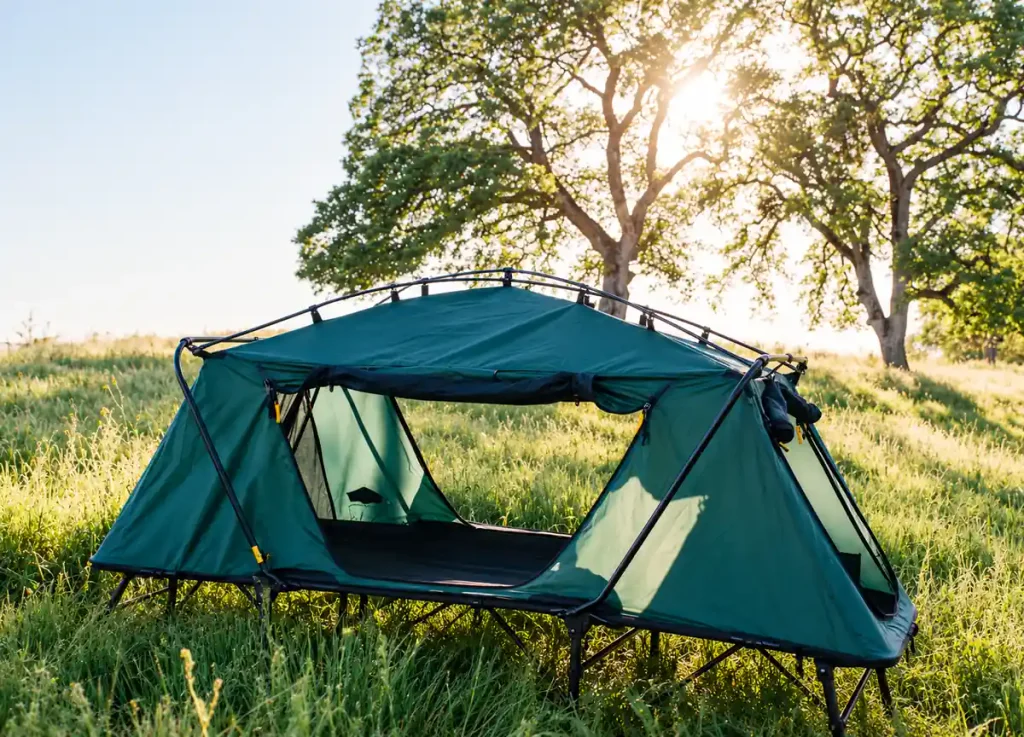
Tent cots are available in several designs, depending on sleeping capacity, frame construction, and how the tent attaches to the cot. For buyers sourcing from China, these differences affect material requirements, assembly, packaging, and supplier evaluation.
Single-Person Tent Cots
Single-person tent cots are designed for one camper and typically use a compact elevated frame with an integrated tent shelter. They are suitable for individual camping and outdoor trips.
Buyers should compare the sleeping dimensions, frame stability, entry design, and folded package size. A smaller product does not always mean a simpler assembly process.
Double Tent Cots
Double tent cots provide a wider sleeping platform for two people. Because of their larger frame and tent structure, buyers should pay particular attention to the rated weight capacity, center support structure, and how the sleeping platform is supported.
Folding Tent Cots
Folding tent cots use collapsible frames designed to reduce setup time and simplify storage. Some models allow the tent and cot to fold together, while others require the shelter to be removed before packing.
The key sourcing checks include folding mechanisms, locking points, hinge durability, and the consistency of assembly instructions.
Detachable Tent Cot Systems
Detachable designs allow the tent shelter to be removed from the cot frame. Depending on the product design, the cot may also be used separately as a standard camping cot. Buyers should pay particular attention to the compatibility of the connecting components.
Before choosing a tent cot type, buyers should research their target market and understand the needs of their intended users. This helps determine which designs and features are most suitable for their camping gear range.
These types are not mutually exclusive. For example, a double tent cot may also feature a folding frame or a detachable tent shelter.
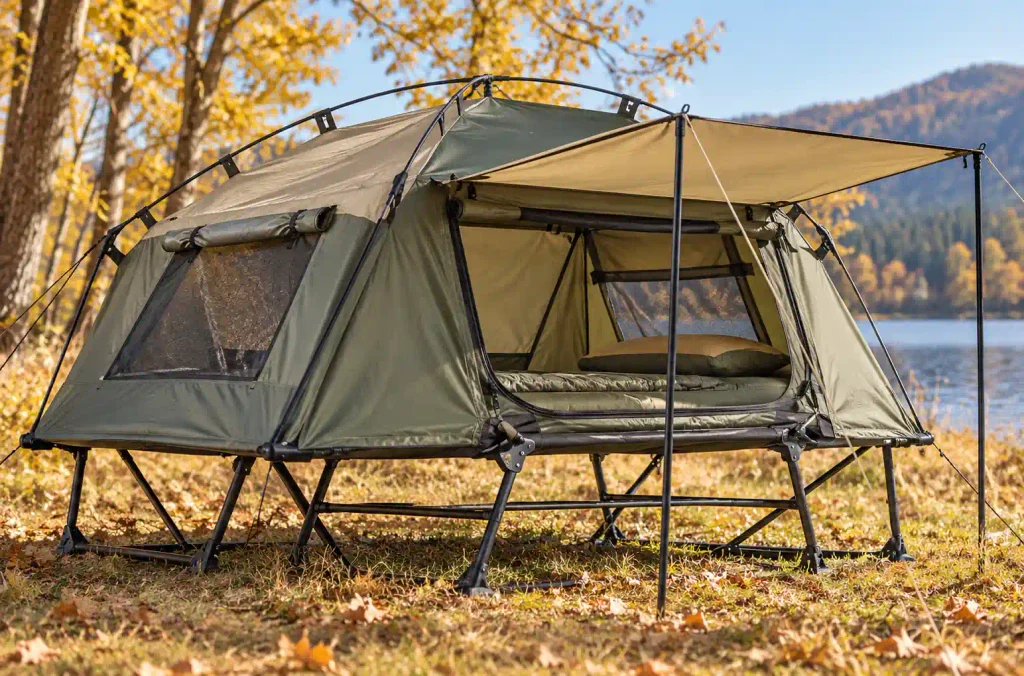
Tent Cot Frame, Fabric, and Shelter Construction
| Component | Common Materials or Structures | Key Considerations |
|---|---|---|
| Frame | Steel or aluminum alloy tubing | Weight, tube dimensions, corrosion protection |
| Sleeping platform | Synthetic woven fabric | Support, stitching, fabric tension |
| Tent body | Polyester or Oxford fabric | Coating, seams, weather protection |
| Rainfly | Coated synthetic fabric | Coverage, attachment, water resistance |
| Mesh panels | Synthetic mesh | Ventilation, insect protection |
| Connecting components | Clips, straps, buckles, poles | Fit, durability, assembly |
Buyers should ask suppliers to provide a complete component checklist and verify each item against the agreed specifications. An approved sample should also be retained as a reference for mass production. Coordinate frame production, fabric preparation, connector availability, and packaging materials against the same production schedule; a late component can hold up final assembly or packing even when the other parts are ready. Track each component’s readiness date and resolve any timing gaps before confirming the shipment plan.
The supplier should assemble the complete tent cot and check the connection points, hinges, locking mechanisms, and fit between the frame and tent shelter. Buyers can review the assembled sample before approval and arrange third-party inspections during production when needed.
Key Tent Cot Specifications Buyers Should Confirm
Tent cot specifications vary by design, sleeping capacity, and intended use. Before requesting quotations for wholesale tent cots, buyers should define the main product requirements so that suppliers can offer comparable models.
| Specification | What to Confirm | Why It Matters |
|---|---|---|
| Sleeping dimensions | Length and width of the sleeping area | Comfort and suitability for target users |
| Overall dimensions | Length, width, and height when assembled | Space requirements and product positioning |
| Height above ground | Distance from the ground to the sleeping platform | Ground clearance and ease of access |
| Weight capacity | Rated maximum load | Safe use and frame selection |
| Product weight | Total weight including the frame and shelter | Portability and handling |
As a published product example, the Kamp-Rite Original Tent Cot lists a bed size of 84 × 28 in (approximately 213 × 71 cm), a stated load capacity of 300 lb (approximately 136 kg), and folded dimensions of 35 × 31 × 6 in (approximately 89 × 79 × 15 cm). These are specifications for one model, not universal tent cot requirements. Buyers should compare usable sleeping space and folded dimensions and confirm the test basis behind the stated load capacity.
Other details, including packed dimensions, frame specifications, fabric coatings, waterproof performance, and setup methods, should also be considered when defining product requirements.
Once the specifications are agreed upon, buyers should ask tent cot suppliers to document them in the product specification sheet and confirm them against an approved sample before mass production.
Tent Cot Product Development
Before starting a tent cot development project, buyers should clarify intellectual property ownership, including the rights to product designs, 3D drawings, and technical files. Both parties should confirm whether a non-disclosure agreement (NDA) is required and agree in writing on development costs, payment terms, and ownership of any tooling.
Developing a tent cot involves more than combining a camping cot with a tent. The frame, tent shelter, support poles, and connecting components must be designed to work together as a complete system. Changes to one component can affect how the entire product fits, folds, and performs during use.
Key development considerations include:
- Frame-to-tent connections: Attachment points, straps, clips, and pole connections must hold the shelter securely in place.
- Dimensions and fabric tension: Frame dimensions, tent panels, and support poles must fit together without excessive tension or loose fabric.
- Folding and detachable designs: Folding mechanisms and removable components should allow practical setup, disassembly, and storage.
- Weather protection at connection points: Tent edges, attachment areas, and rainfly coverage should be designed to help prevent water entry.
A complete prototype is needed to check how these components work together. During sample development, the supplier should assemble the tent cot and check the fit of the shelter, the operation of doors and zippers, and whether the frame and connecting components interfere with folding or setup. For tent cot development projects, buyers should confirm which supplier produces the cot frame, who handles tent fabric cutting and sewing, and who is responsible for final assembly and inspection. The supplier responsible for the complete product should be able to provide approved sample records, relevant test reports, and inspection records covering the assembled tent cot, not just its individual components.
Tent Cot Final Product Inspection
Before shipment, tent cots should be inspected as complete assembled products by the supplier or a third-party inspection company appointed by the buyer. Inspection reports should be provided to the buyer and retained as part of the delivery documentation. Component inspection records should be checked against the agreed specifications, while production samples should be compared with the approved sample to identify changes in dimensions, materials, or connectors before the lot reaches final inspection. Record any deviations and confirm corrective action before shipment release.
Key inspection items include:
- Complete assembly: Confirm that the cot frame, tent body, support poles, and connecting parts fit together correctly, without missing or incompatible components.
- Stability under load: Check frame stability, tent tension, attachment points, and zipper operation under the agreed loading conditions. Confirm the test basis for the stated load capacity, including load distribution, test duration, and acceptance criteria. Also check stability under edge loading, such as when a user sits on the side or gets in and out of the tent cot.
- Setup and folding: Verify that straps, clips, connectors, and folding mechanisms work correctly during assembly, disassembly, and storage.
- Weather protection: Check rainfly coverage, seams, and frame-to-tent connection areas against the agreed waterproofing requirements.
- Product configuration: Confirm that all included components, accessories, and carry bags match the approved sample and packing list.
Not every finished unit needs to undergo all inspection procedures. Buyers can use AQL sampling methods for camping furniture to inspect selected units from a production lot. Visual checks, assembly checks, and functional testing should follow an agreed inspection plan, with appropriate sampling and acceptance criteria. AQL sampling supports production lot acceptance decisions; it does not replace product design validation or safety and performance testing. These should be planned separately and supported by relevant test records for the assembled tent cot.
Tent Cot Packaging and Shipping Considerations
Tent cots combine a folding bed frame with a tent shelter, support poles, and connecting components. Packaging must protect these parts during transportation while keeping the complete product set organized and easy to identify.
Key packaging considerations include:
- Complete set packaging: Confirm whether the cot frame, tent shelter, rainfly, support poles, and accessories are packed together or in separate packages.
- Frame and fabric protection: Protect metal frame ends, hinges, and other hard components from damaging the tent fabric during handling and transportation.
- Small component storage: Secure clips, straps, stakes, and other loose parts in labeled accessory bags to reduce the risk of missing components.
- Carry bag and outer carton: Check that the folded product fits the carry bag and that the outer carton provides suitable protection for shipping.
- Packing dimensions and weight: Confirm the actual carton dimensions, gross weight, and units per carton to estimate shipping volume and container loading.
Before shipment, suppliers should verify the packing configuration against the approved sample and packing list. Buyers should also request final carton dimensions and weights, particularly when comparing freight costs or planning container shipments.
Particular attention should be paid to small components that are easily misplaced. Factory personnel should count these parts before packing and place them in clearly labeled accessory bags. Each bag should be photographed to show which components it contains, and the photos should be shared with the buyer and retained as packing records.
Conclusion
Sourcing tent cots from China requires careful coordination of frames, fabrics, shelters, and connecting components. Clear specifications, approved samples, and documented inspections help ensure product consistency and complete delivery.
JingtuOutdoor helps outdoor brands and importers coordinate supplier selection, product development, sampling, production follow-up, and quality inspections for tent cot sourcing projects in China.
FAQ
How can condensation be reduced in a tent cot?
Condensation can build up inside a tent cot when moisture accumulates and ventilation is limited. Buyers should evaluate mesh panels, adjustable vents, rainfly clearance, and airflow during sample testing, especially for enclosed or single-wall designs.
Can the tent shelter be used separately from the cot frame?
Some tent cots feature detachable shelters, while others are designed as integrated systems. Buyers should confirm whether the shelter can be pitched independently and whether additional poles, stakes, or other components are required.
What is the MOQ for custom tent cots?
Minimum order quantities depend on the supplier, product design, materials, and customization requirements. Adding a logo to an existing model may require a lower MOQ than developing a new frame or tent structure. Buyers should confirm the MOQ for their specific project.
What information is needed for a custom tent cot quotation?
Buyers should provide the tent cot type, dimensions, load capacity, frame and fabric requirements, customization details, estimated order quantity, packaging requirements, and destination market. Product drawings or reference samples can help suppliers prepare more accurate quotations.
What should buyers check before approving a tent cot sample?
Buyers should assemble the complete tent cot and check frame stability, shelter fit, fabric tension, doors, zippers, and folding mechanisms. Confirm the test basis for the stated load capacity and verify that all accessories match the agreed specification sheet.
What packaging details are needed to compare tent cot shipping costs?
Ask suppliers for the final outer carton dimensions, gross weight, units per carton, and packing configuration. Folded product dimensions alone do not establish shipping volume. Also confirm how the frame, tent fabric, poles, and small accessories are protected and packed.