
Camping Furniture Quality Control and Inspection
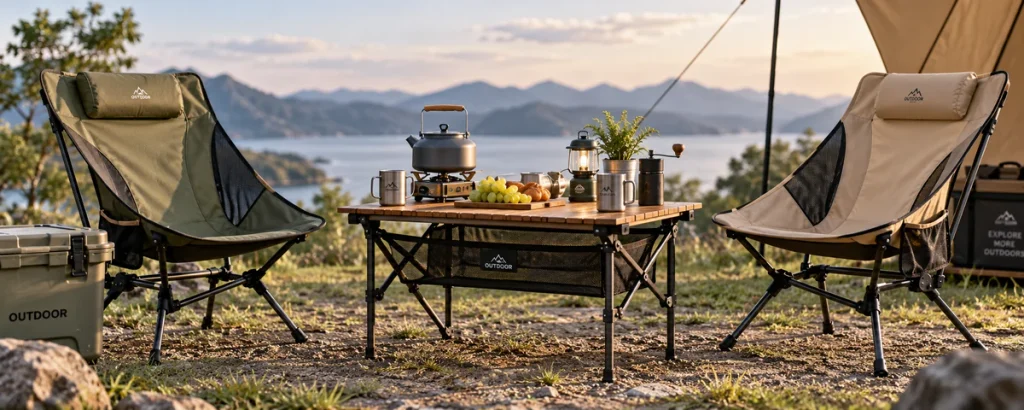
Quality control is one of the most important parts of camping furniture sourcing and can determine the success or failure of a project. It is not limited to a final pre-shipment inspection, but runs through the entire process from sample approval and production to final shipment release. Experienced buyers know that an approved sample does not necessarily mean the mass-produced goods will be fully qualified.
Before production begins, the product specifications, materials, and packaging details should be clearly confirmed. This gives later inspections a clear standard to follow and helps avoid discovering mismatches only at the time of delivery.
Before placing an order, buyers should also verify whether the supplier has the actual production, engineering, sampling, and project experience required for the product. Our guide to evaluating camping furniture OEM/ODM manufacturers in China explains what evidence to request and how to assess the supplier’s answers.
The quality control methods discussed in this article apply to a wide range of camping furniture products, including camping chairs, camping stools, camping cots, camping tables, and more.
- Start with an Approved Sample and Clear Specifications
- Final Inspection: What Should Buyers Check?
- Performance and Functional Testing
- How to Use AQL for Final Random Inspection
- What QC Evidence Should Buyers Require?
- Factory QC vs. Independent Inspection
- What Happens If the Inspection Fails?
- Packaging and Pre-Shipment Checks
- A Practical Camping Furniture QC Checklist for Buyers
- Conclusion
- Frequently Asked Questions
Start with an Approved Sample and Clear Specifications
As a buyer, you should confirm that the factory has approved the sample and clearly defined the product specifications before mass production begins. These will serve as the reference for later production and inspection.
Approved Sample as the Quality Reference
The approved sample should serve as the main reference for mass production and inspection. It helps both the buyer and supplier judge whether the finished products match the agreed quality level.
Finalize the Product Specification
Before production, key product details such as dimensions, materials, colors, logos, accessories, and packaging should be clearly confirmed. These specifications provide the basis for later quality checks.
Confirm the BOM and Critical Components
The BOM and critical components should also be confirmed before mass production. Any change to key materials or parts may affect product consistency, function, or durability.
Final Inspection: What Should Buyers Check?
At the final inspection stage, buyers should verify whether the finished products match the approved sample and agreed specifications. The following areas should be checked across the randomly selected samples.
| Inspection Area | What to Check |
|---|---|
| Appearance & Workmanship | Scratches, stains, sharp edges, poor finishing, uneven surfaces, damaged parts, and other visible workmanship defects |
| Dimensions & Product Consistency | Overall dimensions, folded dimensions, key product dimensions, and consistency across inspected samples |
| Frame & Structural Stability | Uneven legs, wobbling, frame distortion, loose joints, and other structural issues |
| Folding & Locking Mechanisms | Smooth opening and folding, proper locking, jamming, excessive looseness, and misalignment |
| Fabric, Stitching & Seams | Fabric defects, uneven tension, loose stitching, seam opening, and attachment to the frame |
| Accessories, Logo & Labels | Carry bags, foot caps, required accessories, logo position, color, labels, barcodes, and other buyer-specific requirements |
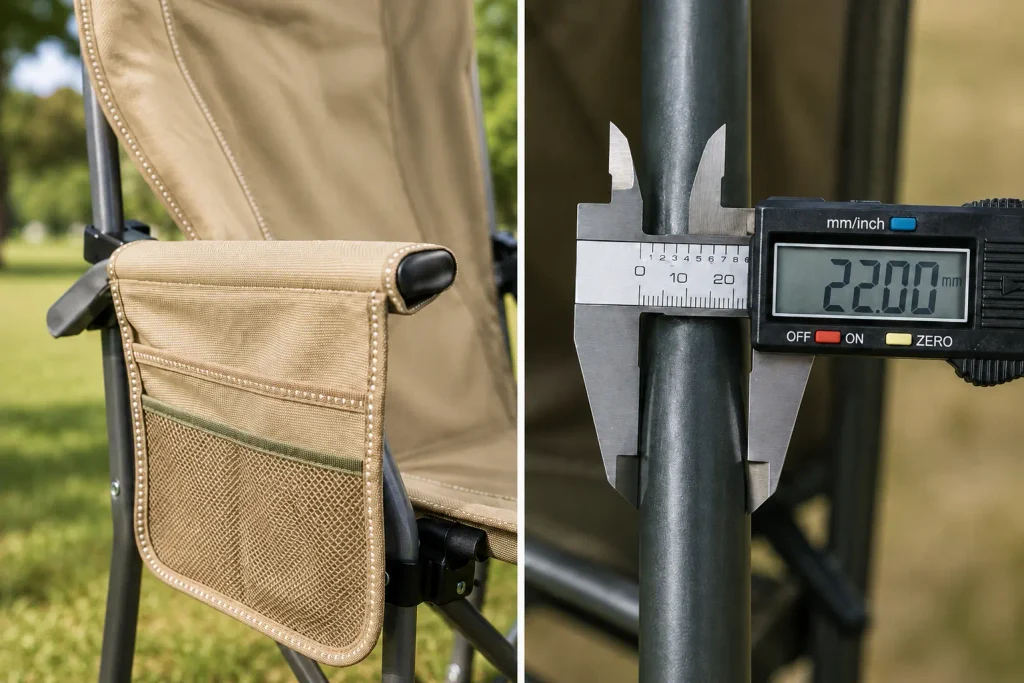
While the general inspection process is similar, the key inspection points vary depending on the type of camping furniture. Buyers should focus on the critical areas based on each product’s structure and use. For example, when inspecting camping chairs, priority areas include the frame and welds, folding and locking mechanisms, fabric and stitching, rivets and joints, and overall load-bearing stability.
Performance and Functional Testing
Routine inspection checks and product validation testing serve different purposes. Buyers should define them separately so that a final random inspection is not treated as a substitute for formal product testing.
Routine Inspection Checks
Routine checks can normally be completed at the factory during an in-process or final inspection, provided that the method, equipment, sample quantity, and acceptance criteria have been agreed in advance.
- Dimensions and Appearance: Measure agreed dimensions and check workmanship, finish, labels, accessories, and consistency with the approved sample.
- Folding and Locking: Open, fold, assemble, and lock the product to check for jamming, misalignment, excessive looseness, or incomplete engagement.
- Basic Stability: Place the product on an appropriate level surface and check for uneven contact, excessive wobbling, or obvious imbalance.
- Agreed On-Site Load Check: Perform a limited load check only when the load, position, duration, equipment, and acceptance criteria have been specified. This check verifies the inspected samples under the agreed conditions; it is not a certification of the product’s full structural performance.
Product Validation and Laboratory Testing
Formal validation is used when the buyer needs evidence of structural performance, durability, material performance, chemical compliance, or conformity with a specified standard. These tests may require calibrated equipment, controlled conditions, a defined sample-preparation method, and a qualified laboratory or test facility.
- Structural and Durability Testing: Static load, impact, fatigue, repeated folding, stability, or other tests performed according to a defined method.
- Fabric and Seam Testing: Tensile, tear, seam strength, abrasion, colorfastness, coating, or other material tests where relevant to the product specification.
- Chemical and Compliance Testing: Restricted-substance, labeling, traceability, or other market-specific requirements applicable to the actual product and target market.
- Standards-Based Testing: Testing to an applicable standard or buyer protocol using the required test conditions, equipment, and reporting format.
Buyer Note: Product validation should normally be completed before mass production or after any material or structural change that may affect performance. Final random inspection then verifies production consistency and the agreed routine checks; it does not replace laboratory testing, standards-based testing, or the applicable compliance documentation.
How to Use AQL for Final Random Inspection
AQL stands for Acceptance Quality Limit. It is used with a defined acceptance-sampling plan, such as ISO 2859-1:2026, to determine the sample size and the acceptance or rejection numbers for an inspection lot. It supports a consistent sampling decision, but it is not a guarantee that the entire lot is defect-free.
• Sample Size: The number of units inspected depends on the lot size, inspection level, sampling plan, and selected AQL values.
• Defect Classification: Critical, major, and minor defects should be defined and agreed before the inspection. The classification should reflect the product, safety risk, intended use, approved specifications, and buyer requirements.
• Acceptance and Rejection Numbers: The selected sampling plan provides the Ac and Re numbers used to judge the inspected sample. The result shows whether the lot passes or fails the agreed sampling criteria.
• Inspection Result vs. Shipment Release: A Pass or Fail result in the inspection report is not automatically the buyer’s final commercial release decision. The buyer should also consider defect severity, contractual requirements, safety concerns, corrective action, reinspection results, and other agreed conditions before authorizing shipment.
• Limits of AQL Sampling: AQL evaluates a randomly selected sample rather than every unit in the lot. A passing result therefore does not prove that the shipment contains no defective products.
• Avoid Misunderstanding AQL 2.5: AQL 2.5 does not mean that the buyer has agreed to accept 2.5% defective products in the shipment. It is an index used with the sampling plan to determine the applicable acceptance and rejection numbers.
What QC Evidence Should Buyers Require?
During inspection, buyers should not rely only on a simple “Pass” result. They should receive clear and traceable evidence showing what was checked, what defects were found, and whether the products met the agreed requirements.
| QC Evidence | What Buyers Should Check |
|---|---|
| Inspection Checklist | The items inspected and the acceptance criteria used for each check |
| Measurement Records | Actual measurements of key dimensions compared with the approved specifications |
| Product and Defect Photos | Photos of randomly inspected products, important details, and any defects found |
| Functional Test Records | Results of folding, locking, stability, and other required functional checks |
| Lot and Sampling Information | Total lot quantity, sample size, and information about the inspected samples |
| Final Inspection Report | Inspection findings, defect summary, and the final Pass / Fail result |
| Packaging and Label Evidence | Photos confirming packaging, labels, barcodes, shipping marks, and other order requirements |

Factory QC vs. Independent Inspection
| Inspection Option | When It Is More Suitable | Main Advantages | Main Limitations |
|---|---|---|---|
| Factory QC | Repeat orders, mature suppliers, stable products, and lower-risk orders | Faster communication, lower cost, and easier access to production records | The factory is checking its own production, so independence may be limited |
| Independent Inspection | New suppliers, first orders, customized products, previous quality issues, large shipments, or higher-risk orders | More independent assessment, random sampling, and clearer buyer-side reporting | Adds inspection cost and requires coordination before shipment |
Summary:
Factory QC can be sufficient for stable, repeat orders with reliable suppliers, while independent inspection is more useful when the buyer needs an additional level of verification. Regardless of who performs the inspection, random sampling is important because the inspected products should represent the production lot rather than samples selected in advance by the factory.
What Happens If the Inspection Fails?
If the final inspection does not meet the agreed requirements, buyers should not rush to release the shipment. The next step is to identify the problem, require corrective action where necessary, verify the result through reinspection, and then decide whether the goods can be shipped.
• Identify the Problem: Determine what defects were found and whether they are isolated issues or part of a wider batch problem.
• Hold Shipment if Necessary: If the defects affect safety, function, or agreed specifications, the shipment should be put on hold until the problem is resolved.
• Corrective Action and Rework: Require the supplier to sort, repair, replace, or rework the affected products and address the root cause where necessary.
• Reinspection: After corrective action is completed, the products should be checked again to confirm that the problem has been properly corrected.
• Shipment Release Decision: Release the shipment only after the inspection result is acceptable; otherwise, continue the hold and require further corrective action.
Packaging and Pre-Shipment Checks
Before shipment, buyers should confirm that the packaging, labels, accessories, and carton information match the approved order requirements.
• Unit Packaging: Check the carry bag, inner protection, accessories, and packing consistency.
• Labels and Barcodes: Confirm that labels and barcodes are correct and match the approved requirements.
• Export Cartons and Shipping Marks: Check carton quantity, carton condition, shipping marks, and overall packing consistency.
A Practical Camping Furniture QC Checklist for Buyers
A simple QC checklist helps buyers make sure that the key requirements are checked at each stage, from approved specifications to final shipment release.
| Stage | Key Checks | Evidence |
|---|---|---|
| Pre-Production | Approved sample, specifications, BOM | Approved records |
| Material / Component Confirmation | Key materials and components | Photos or supplier records |
| During Production | Welding, sewing, assembly, finishing | In-process records or photos |
| Final Product Inspection | Dimensions, workmanship, function, consistency | Inspection records |
| Performance Testing | Load, stability, folding, durability | Test records |
| Final Random Inspection | AQL, defects, quantity | Final inspection report |
| Packaging | Labels, accessories, cartons, shipping marks | Packing photos |
| Shipment Release | Pass, corrective action, reinspection | Final release decision |
Conclusion
Effective camping furniture quality control requires more than a final inspection. Buyers need clear specifications, reliable inspection evidence, corrective action when problems are found, and a clear shipment release decision. If you need help communicating quality requirements to suppliers or coordinating with independent inspection providers in China, learn more about JingtuOutdoor’s outdoor product sourcing support and contact us to discuss your sourcing plan.
Frequently Asked Questions
What should be inspected before camping furniture is shipped?
Before shipment, buyers should check appearance, dimensions, structure, folding and locking functions, fabric and stitching, accessories, labels, packaging, and other agreed product requirements.
What is AQL in camping furniture inspection?
AQL is a sampling method used during final random inspection to determine whether a production lot should be accepted or rejected.
Is factory QC enough for a camping furniture order?
Factory QC may be suitable for stable repeat orders with reliable suppliers. For new suppliers, first orders, customized products, or higher-risk shipments, independent inspection can provide an additional level of verification.
What happens if a pre-shipment inspection fails?
The buyer should identify the problem, hold the shipment when necessary, require corrective action or rework, and arrange reinspection before deciding whether the goods can be released.
How can buyers make sure mass production matches the approved sample?
Buyers should use the approved sample and confirmed specifications as the quality reference, then verify consistency through production follow-up and final inspection.