
How to Find Camping Furniture OEM/ODM Manufacturers in China
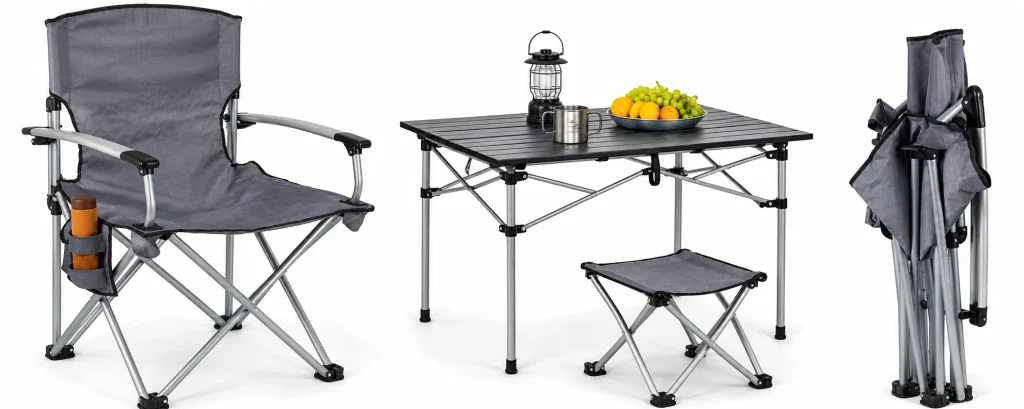
If you are developing a camping furniture product, or if your requirements go beyond simply changing the logo, color, or packaging, finding the right OEM/ODM manufacturer is very important.
China has a highly developed camping furniture supply chain, but the level of support different suppliers can provide varies significantly. The key is to determine whether they have the engineering, prototyping, tooling, and mass production capabilities that match your project.
This guide will help you find camping furniture OEM/ODM manufacturers for products such as camping chairs, camping tables, camping stools, and camping cots. It will also help you assess whether a supplier has real product development capabilities and identify the key questions you should confirm before working with them.
- What Type of Camping Furniture Manufacturer Do You Need?
- Where to Find Camping Furniture OEM/ODM Manufacturers in China
- How to Verify Real OEM/ODM Capability
- What Information Should You Prepare Before Contacting a Manufacturer?
- Typical OEM/ODM Development Process for Camping Furniture
- Costs, MOQ, and Lead Time
- How to Pay for an OEM/ODM Camping Furniture Project
- Conclusion
- Frequently Asked Questions
What Type of Camping Furniture Manufacturer Do You Need?
Before searching for a camping furniture manufacturer, first determine the level of manufacturing support your project requires. Depending on your product development stage and customization needs, you may need basic customization, OEM manufacturing, or more comprehensive ODM product development support.
Basic Customization / Private Label
If your requirements are limited to changes such as the logo, color, fabric, labels, or packaging, while the product structure remains largely unchanged, you usually do not need strong product development capabilities. In this case, a manufacturer offering basic customization or private label services may be sufficient.
OEM Manufacturing
If you already have a clear product design, drawings, dimensions, and specifications, and you want the factory to manufacture according to your requirements, an OEM manufacturer is usually the better fit. In addition to production, you should confirm whether the supplier can support prototyping, engineering adjustments, tooling development, and mass production.
ODM / Product Development
If your product is still at the concept stage, or if you need the supplier to support structural design, material selection, prototype development, testing, and product optimization, you should look for a manufacturer with stronger ODM or product development capabilities. This type of supplier should be able to turn a product concept into a manufacturable and mass-production-ready solution.
Where to Find Camping Furniture OEM/ODM Manufacturers in China
Find Manufacturers Through Google and China’s Camping Furniture Industrial Clusters
When searching for camping furniture manufacturers on Google, avoid relying only on broad keywords such as camping furniture manufacturer China. A more effective approach is to combine specific product terms with keywords such as OEM/ODM, custom manufacturer, product development, and industrial cluster or location names, for example:
camping chair OEM manufacturer Wuyicamping furniture manufacturer Jinhuaoutdoor furniture factory Yongkangcamping furniture supplier Ningbo
This search approach can help narrow down your supplier list and make it easier to identify manufacturers that are relevant to your project.
Once you identify potential manufacturers, do not rely on Google rankings alone. Check their product range, engineering team, prototyping capability, tooling development, production processes, and evidence of previous OEM/ODM projects.
Find Manufacturers on Alibaba, Made-in-China, and Global Sources
Alibaba, Made-in-China, and Global Sources can help you quickly shortlist camping furniture suppliers. Use keywords such as camping furniture OEM, camping chair ODM, and custom camping furniture, and focus on product range, Manufacturer/Factory status, OEM/ODM services, MOQ, and evidence of R&D or engineering support.
An “OEM” or “ODM” label on a B2B platform should only be treated as an initial screening signal. It does not prove real product development capability, which should be verified through technical discussions, sample development, and relevant project experience.
Find Manufacturers at Trade Shows
Trade shows are useful, but they work best when you plan ahead and go with a clear product focus. If you’re still exploring options, start with online sourcing channels like Google and B2B platforms to build an initial shortlist. Once you know what you need—such as sampling, engineering support, or OEM capabilities—attending a relevant trade show can help you evaluate suppliers in person and compare multiple booths efficiently.
Find Manufacturers Through Local Sourcing Networks and Sourcing Agents
If your project involves new product development, structural modifications, tooling, or multiple processes, local sourcing networks and sourcing agents can help you reach manufacturers that are not easy to find on public platforms. This approach usually involves sourcing service fees and is more suitable for ongoing development and on-site coordination OEM/ODM projects rather than standard product sourcing.
How to Verify Real OEM/ODM Capability
A supplier claiming to offer OEM or ODM services does not necessarily mean that it has real product development capabilities. For camping furniture projects, the key is to verify whether the manufacturer has the right engineering team, relevant project experience, and the ability to manage the full development process from prototyping and tooling to production and testing.
Evaluate the Engineering and Product Development Team
Check whether the supplier has engineers who are directly involved in product development and whether they can support structural design, material selection, technical drawings, and product modifications.
Verify In-House Production and Outsourced Processes
Confirm which processes are completed in-house and which are outsourced, such as tube cutting and bending, welding, powder coating, fabric sewing, plastic components, assembly, and packaging. Ask the supplier to provide workshop photos or videos, a clear list of outsourced processes, and an explanation of how subcontractors are selected, inspected, and controlled. A reliable manufacturer should be able to explain its actual production scope clearly and show how quality remains consistent across both in-house and outsourced operations.
Review Previous OEM/ODM Project Experience
Look at whether the supplier has handled projects similar to yours and whether they can show real development experience from concept and prototyping through revisions and mass production.
Verify Prototyping, Tooling, Production, and Testing Capabilities
Evaluate prototyping, sample revisions, tooling development, production processes, and testing together to determine whether the supplier can turn a design into a stable mass-production product.
What Information Should You Prepare Before Contacting a Manufacturer?
Before contacting an OEM/ODM manufacturer, the clearer your project information is, the easier it is for the supplier to assess feasibility and provide a more accurate development proposal and quotation. Even if you do not have complete drawings yet, you should provide as much basic information as possible.
| Information to Prepare | What to Include |
|---|---|
| Product Concept and References | Product type, intended use, reference images, sketches, or similar products |
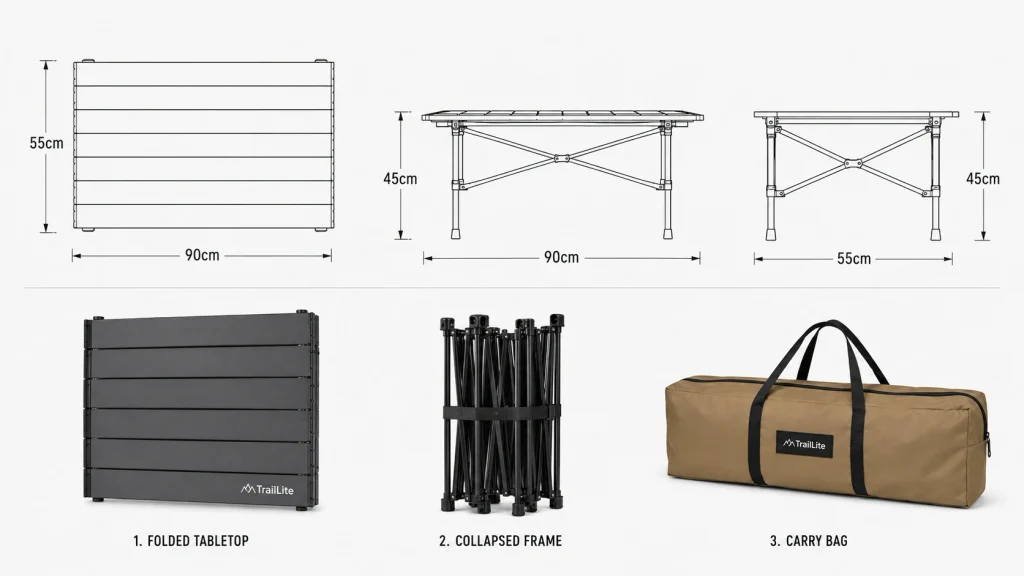
| Dimensions and Key Specifications | Main dimensions, target weight, load requirements, folded size, and other key specifications |
| Materials and Construction Requirements | Tubing, fabric, plastic parts, hardware, surface finishing, or target performance requirements |
| Target Market, Quantity, and Price | Sales market, compliance requirements, initial order quantity, expected future volume, and approximate target price |
| Branding and Packaging | Logo, colors, labels, packaging, storage bags, or other branding requirements |
| Drawings and Technical Files | 2D drawings, 3D CAD files, BOM, technical specifications, or a reference/golden sample |
Typical OEM/ODM Development Process for Camping Furniture
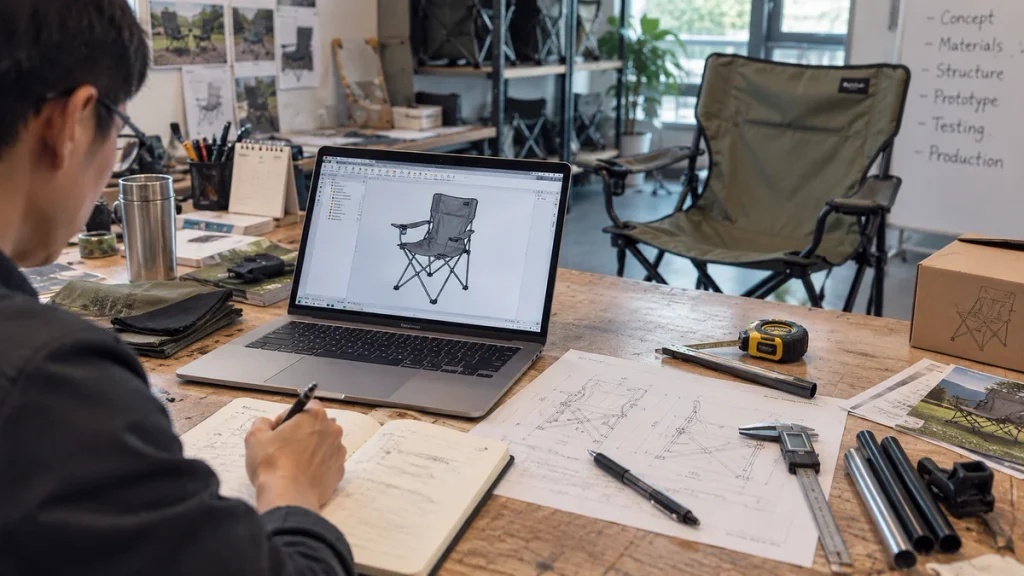
A camping furniture OEM/ODM project usually goes through several stages before mass production. The exact process may vary by product and supplier, but the key is to confirm each stage clearly before moving to the next.
| Stage | What Happens |
|---|---|
| Requirement Clarification | Confirm the product concept, dimensions, materials, target market, quantity, and key performance requirements |
| Feasibility Review | The supplier evaluates whether the product can be manufactured and identifies possible technical or cost issues |
| Quotation | Initial pricing is prepared based on the confirmed requirements, development work, tooling, and expected production volume |
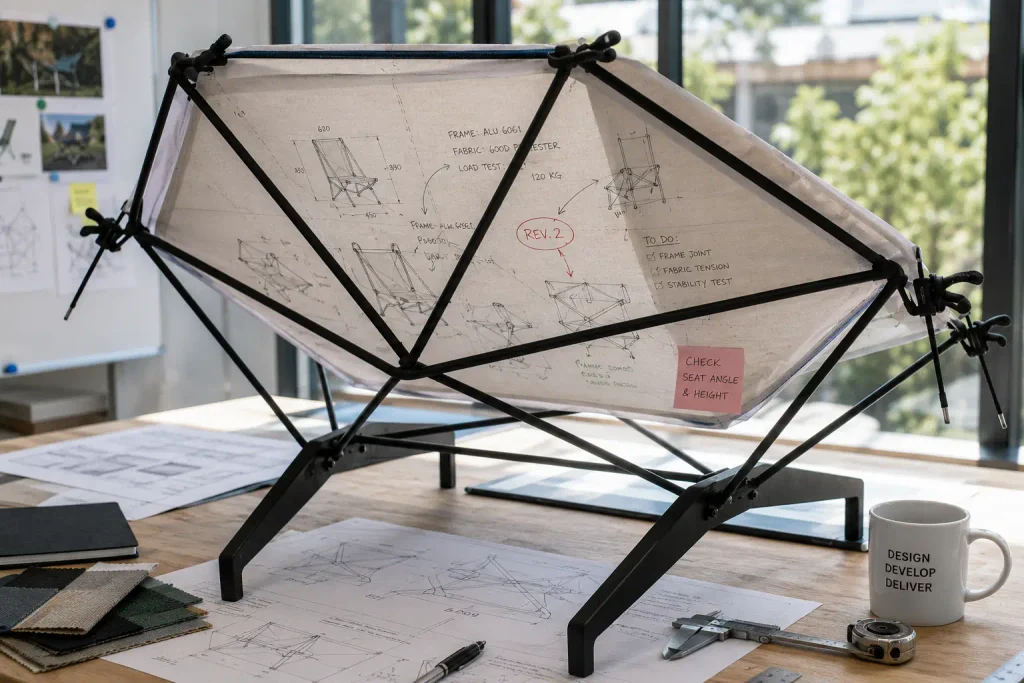
| Engineering and Design | Product structure, materials, components, and technical details are reviewed or developed |
| Prototype Development | The supplier produces the first sample or prototype for evaluation |
| Sample Review and Revision | The buyer reviews the sample and confirms any required changes before final approval |
| Tooling and Testing | Molds, fixtures, or other tooling are developed if needed, and the product is tested according to project requirements |
| Pilot Production | A small production run is used to verify the manufacturing process and identify problems before full production |
| Mass Production | After the sample, tooling, and production process are approved, the order moves into mass production |
| Final Inspection and Shipment | Finished goods are inspected before shipment according to the agreed quality requirements |
Costs, MOQ, and Lead Time
OEM/ODM project costs and timelines depend on the level of development, product structure, materials, tooling, and order quantity. In addition to the unit price, buyers should confirm the costs involved during development, as well as the MOQ and overall project timeline.
Key points to confirm include:
- Design, engineering, and development fees
- Prototype and sample costs
- Tooling and mold costs
- Testing and packaging development costs
- MOQ and initial order quantity
- Development timeline
- Mass-production lead time
For new product development, it is better to confirm the development timeline and mass-production lead time separately, since the early stages may also include feasibility review, sample revisions, tooling, testing, and pilot production.
How to Pay for an OEM/ODM Camping Furniture Project
Payments for an OEM/ODM project should ideally follow the development stages rather than being heavily front-loaded. These projects often involve feasibility review, design, prototyping, tooling, testing, and mass production, and each stage carries different work requirements and risks.
Key payment points to confirm include:
- What deliverables are included in feasibility or design fees
- How many sample revisions are covered
- When tooling and mold fees are due
- Tooling ownership, storage, and maintenance responsibilities
- Who pays for testing or certification
- Deposit and balance terms for mass production
- What acceptance result is required before each payment milestone
A safer approach is to link payments to project milestones—for example, moving to the next payment only after feasibility review, sample approval, tooling completion, or pilot production has been confirmed. This helps reduce upfront risk and ensures that each payment is tied to a clear deliverable.
Conclusion
Finding a camping furniture OEM/ODM manufacturer is not just about locating a factory that can make the product. The key is to confirm whether the supplier has the development capabilities that match your project, including the engineering team, relevant OEM/ODM experience, prototyping, tooling, production, and testing capabilities, while also clarifying project information, costs, MOQ, lead time, and payment milestones.
JingtuOutdoor helps overseas buyers find and coordinate suitable camping furniture manufacturers in China, especially for OEM/ODM projects involving new product development, structural modifications, tooling, or multiple manufacturing processes. We help match buyers with the right manufacturing resources and support the project from initial evaluation through sampling and mass production.
Frequently Asked Questions
What is the difference between OEM and ODM camping furniture?
OEM usually means producing to the buyer’s design or specifications, while ODM involves more product development support. Because suppliers may use these terms differently, always confirm the actual scope of work.
Can a manufacturer develop a product from a reference image?
Yes, but reference images alone are usually not enough. Dimensions, materials, intended use, target market, and performance requirements may still be needed.
Do I need CAD drawings before contacting a manufacturer?
Not always. For early-stage projects, reference images, sketches, dimensions, and basic requirements may be enough for an initial feasibility review.
How can I verify real ODM capability?
Check whether the supplier has an engineering team, relevant project experience, prototyping, tooling, testing, and the ability to move from concept to mass production.
Who owns the mold or tooling?
This should be agreed before payment, including ownership, storage, maintenance, and whether the tooling can be transferred.
How long does an OEM/ODM project take?
It depends on product complexity, sample revisions, tooling, testing, and pilot production. Development time and mass-production lead time should be confirmed separately.