
Camping Chair Packaging Guide for B2B Buyers
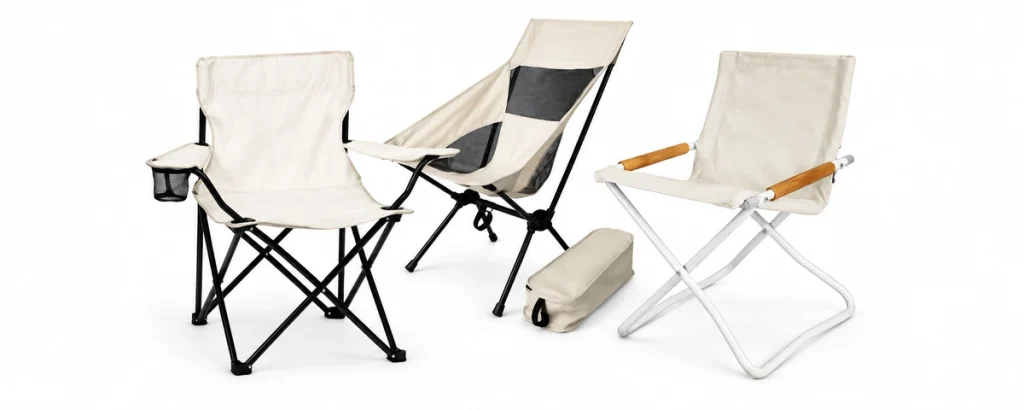
Container loading is an important part of the camping chair sourcing process. However, many buyers focus first on the FOB price and may overlook how packaging and loading efficiency affect the final cost.
What matters is not only the product price, but also the folded size, carton configuration, CBM per unit, and how efficiently the cartons can actually be loaded into a container.
This guide explains how B2B buyers can compare camping chair packaging, calculate CBM, evaluate container loading efficiency, and verify whether a supplier’s claimed loading quantity is realistic before placing a bulk order.
- Why Packaging and CBM Matter When Sourcing Camping Chairs
- How to Calculate CBM for Camping Chairs
- How Packaging Configuration Affects Container Loading
- How to Estimate Camping Chair Container Loading Quantity
- How to Compare Two Camping Chair Quotations Using CBM
- Final Packaging and Loading Check Before Shipment
- Conclusion
- Frequently Asked Questions
Why Packaging and CBM Matter When Sourcing Camping Chairs
Packaging directly affects how many custom camping chairs can fit into a container and how much freight cost is allocated to each unit. It should be evaluated as part of the broader camping furniture sourcing process.
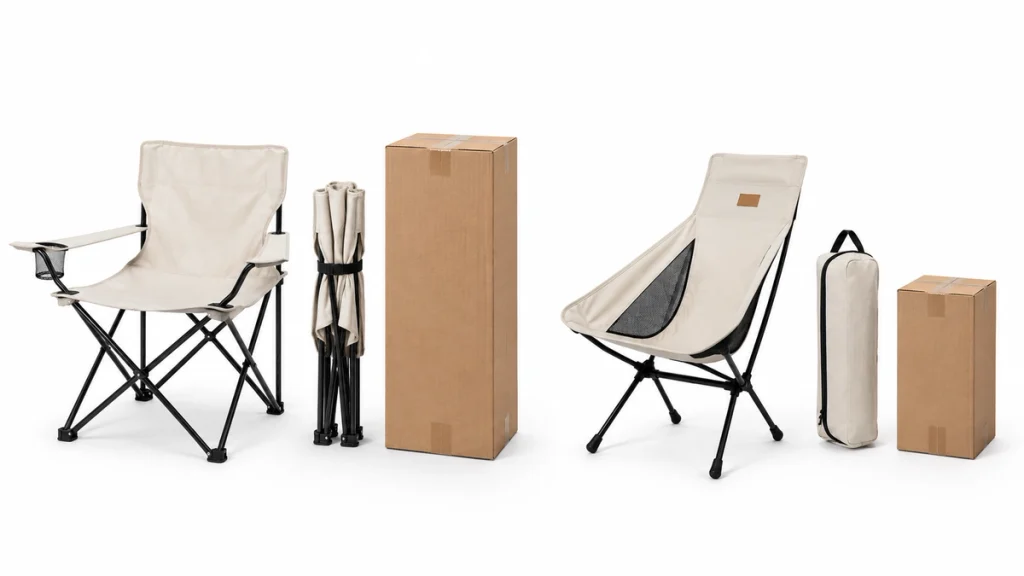
CBM stands for cubic meter and is used to measure the volume of cargo. For camping chairs, CBM is usually calculated based on the packed carton dimensions, so it gives buyers a practical way to understand how much container space each chair will occupy.
Two camping chairs may have similar FOB prices but very different folded sizes, carton dimensions, and CBM per unit. A bulkier packing configuration can take up more container space, reduce the total loading quantity, and increase the freight cost per chair.
Buyers should therefore compare:
- folded size
- carton dimensions
- quantity per carton
- CBM per unit
- estimated container loading quantity
These figures should be reviewed together with the FOB price, because a lower unit price does not always result in a lower landed cost.
How to Calculate CBM for Camping Chairs
CBM is calculated from the packed carton dimensions.
If the carton size is measured in centimeters, the formula is:
CBM per carton = Length × Width × Height ÷ 1,000,000
For example, a carton measuring 60 × 35 × 90 cm equals:
0.189 CBM
If the carton contains 2 chairs:
CBM per chair = 0.189 ÷ 2 = 0.0945 CBM
Buyers should always confirm that the supplier’s CBM is based on the final packed carton size, because even a small difference in carton dimensions can affect the estimated loading quantity.
How Packaging Configuration Affects Container Loading
The same camping chair can have very different loading efficiency depending on how it is packed.
A supplier may pack chairs individually, several pieces per carton, nested together, or with removable parts to reduce the packed volume. These choices can change the carton size, CBM per chair, and the final number of units that fit into a container.
Buyers should compare:
- quantity per carton
- carton dimensions
- whether chairs can be nested
- whether legs, armrests, or accessories are packed separately
- whether the packaging leaves unnecessary empty space
A more compact carton does not always mean better protection, so packaging efficiency should be balanced with product protection during transport and verified through appropriate camping furniture quality control.
How to Estimate Camping Chair Container Loading Quantity
The number of camping chairs that can fit into a container depends on the packed carton size, quantity per carton, and actual loading efficiency. It should not be estimated by container volume alone.
Theoretical container volume can be used as a starting point, but the final loading quantity is usually lower because cartons cannot use every part of the available space.
Theoretical Container Volume
Typical internal container volumes are approximately:
| Container Type | Approx. Internal Volume |
|---|---|
| 20GP | 33 CBM |
| 40GP | 67 CBM |
| 40HQ | 76 CBM |
These figures are useful for initial calculations, but they do not represent the volume that can always be fully used in actual loading. Maersk’s dry cargo guidance also notes that exact internal dimensions and usable capacity may vary by carrier and container series.
Why Actual Loading Is Lower
Actual loading quantity can be affected by:
- carton dimensions and shape
- stacking direction
- gaps between cartons
- container door clearance
- weight distribution
- palletization
- accessories packed separately
- mixed-SKU loading
For this reason, buyers should treat a simple container CBM ÷ CBM per chair calculation as a theoretical estimate rather than the final loading quantity.
Example Loading Calculation
If one camping chair occupies 0.095 CBM, a simple calculation for a 40HQ would be:
76 ÷ 0.095 = 800 chairs
This volume-based calculation does not mean that 800 chairs will actually fit. A practical loading plan should also show how many cartons fit along the container’s internal length, width, and height, because carton dimensions may leave unusable space even when the total CBM appears sufficient.
The final quantity should be checked against the carton dimensions, loading orientation, and preferably a supplier’s previous loading record or loading plan.
Why Supplier-Quoted Loading Quantities Need to Be Verified
A supplier’s quoted container loading quantity should be treated as a reference rather than a guaranteed figure. In many cases, the number is based on theoretical volume rather than actual loading conditions.
Before relying on a supplier’s loading claim, buyers should confirm:
- final carton dimensions
- quantity per carton
- CBM per carton
- whether the figure is theoretical or based on actual loading
- whether pallets are used
- whether accessories are packed separately
- whether the shipment includes mixed SKUs
Previous loading photos or shipment records are useful references, but buyers should still verify the current carton specifications because packaging revisions, mixed SKUs, and different container series can change the final result.
How to Compare Two Camping Chair Quotations Using CBM
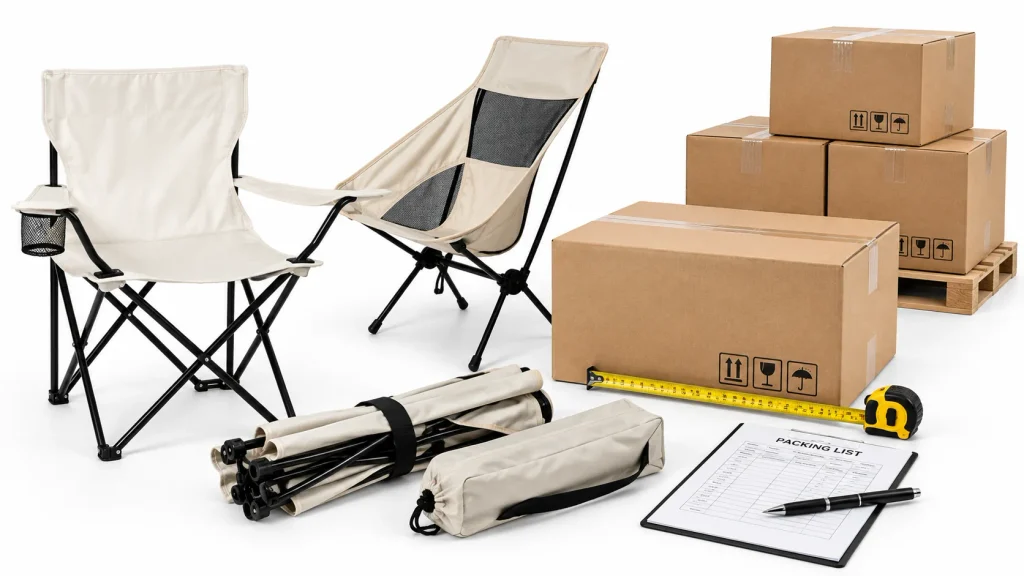
A lower FOB price does not always mean a lower total cost. When comparing two camping chair quotations, buyers should look at the product price together with CBM per chair and estimated container loading quantity.
The following simplified example uses illustrative figures to show how packaging efficiency can change the cost comparison:
| Item | Chair A | Chair B |
|---|---|---|
| FOB Price | $18.00 | $18.80 |
| CBM per Chair | 0.105 | 0.085 |
| Theoretical 40HQ Quantity | 720 pcs | 890 pcs |
| Estimated Freight per Chair | Higher | Lower |
Chair A has the lower FOB price, but Chair B uses container space more efficiently. Depending on the freight rate, Chair B may result in a lower landed cost per unit.
For B2B buyers, the better quotation is therefore not always the one with the lowest FOB price. The more useful comparison is:
FOB price + estimated ocean freight per unit provides a more realistic initial cost comparison. For a complete landed-cost calculation, buyers should also consider duties, insurance, customs clearance, destination charges, and inland transportation.
Final Packaging and Loading Check Before Shipment
Before mass production, buyers will usually have already confirmed the packaging requirements, carton specifications, quantity per carton, and estimated loading data. Before shipment, these figures should be checked again against the final production packaging to make sure the actual data is still consistent with the original calculation.
Buyers should review:
- final folded size
- final carton dimensions
- quantity per carton
- CBM per carton
- CBM per chair
- net weight and gross weight
- total cargo gross weight
- container maximum payload and route-specific weight restrictions
- whether the shipment will be floor-loaded or palletized
- final estimated container loading quantity
- whether accessories are packed separately
- whether mixed-SKU loading is involved
If the final carton dimensions, packing method, or accessory packaging changes, the CBM and loading quantity should be recalculated. This helps avoid a mismatch between the figures used during quotation or freight estimation and the actual packaging used for shipment.
Conclusion
For camping chair buyers, packaging and container loading should be evaluated together with the product price. A lower FOB price does not always mean a lower landed cost if the chair uses more container space.
CBM provides a useful basis for estimating shipping volume, but buyers should still verify the final carton dimensions, packing method, and actual loading conditions. This helps compare quotations more accurately and reduce unexpected freight differences before shipment.
JingtuOutdoor provides outdoor products sourcing and product development support for overseas buyers sourcing camping chairs and other outdoor products from China. If you are sourcing camping chairs from China, contact us for support with packaging evaluation, container loading data verification, and supplier coordination.
Frequently Asked Questions
What is CBM in camping chair shipping?
CBM stands for cubic meter and is used to measure cargo volume. For camping chairs, it is usually calculated from the final packed carton dimensions and is used to estimate shipping volume and container loading quantity.
Can container loading quantity be calculated only from CBM?
Not accurately. Dividing container volume by CBM per chair can provide a theoretical estimate, but actual loading also depends on carton dimensions, stacking direction, unused space, pallets, accessories, and mixed-SKU loading.
Why can two camping chairs with similar FOB prices have different landed costs?
The packed volume may be different. A chair with a higher CBM per unit uses more container space and may result in a higher freight cost per chair, even if its FOB price is lower.
Is smaller packaging always better?
No. More compact packaging can improve container efficiency, but it still needs to protect the chair during handling and transportation. Packaging efficiency and product protection should be considered together.
How can buyers verify a supplier’s container loading quantity?
Buyers should verify the supplier’s figure against the final carton dimensions, quantity per carton, loading method, and a carton-level loading plan. Previous shipment records can provide useful reference, but they do not guarantee the same result if the packaging, container series, or SKU mix changes.