
Hunting Chair Suppliers in China
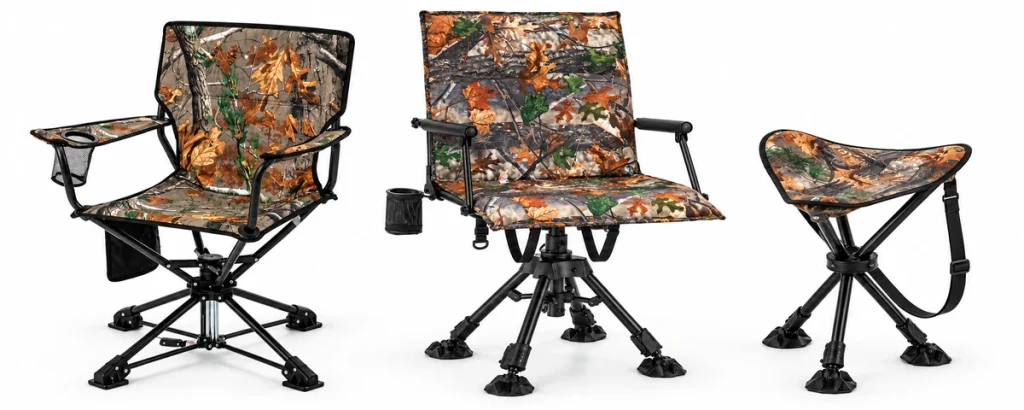
A hunting chair is a portable outdoor seat designed for hunting, blind use, and other situations where users may remain seated for extended periods. In the broader outdoor products market, some hunting chairs overlap with camping chair designs in their folding structure, portability, and basic frame construction, while swivel models and chairs with adjustable legs are more specialized for hunting use.
Hunting chairs are commonly used in outdoor situations that require long periods of sitting and frequent changes in viewing direction. Common structures include tripod stools, folding chairs with backrests, 360° swivel chairs, and models with adjustable legs. Buyers should first define their specific requirements before comparing suppliers and quotations.
This guide covers the main hunting chair types, key specifications, Chinese supplier screening, customization, sample review, quality control, and common sourcing risks, helping buyers compare suppliers and quotations using more specific product data.
- Common Hunting Chair Designs and Features
- What Makes a Hunting Chair Different from a General Camping Chair?
- Key Specifications to Confirm Before Comparing Quotes
- How to Evaluate Chinese Hunting Chair Suppliers
- Hunting Chair Accessories and Optional Features
- Customization Options for Hunting Chairs
- How Buyers Should Review a Hunting Chair Sample
- Compliance and Testing for Hunting Chairs
- Common Sourcing Risks
- Conclusion
- FAQ
Common Hunting Chair Designs and Features
Hunting chairs are one of the most common types of hunting seats and can be described by their frame structure, use setting, or added functions. The following designs and features may overlap in a single product, so buyers should compare the actual construction and specifications.
Tripod Hunting Chairs
A tripod hunting chair uses a three-leg frame that can fold into a compact package. Compare its carrying size and stability on the intended ground.
Hunting Blind Chairs
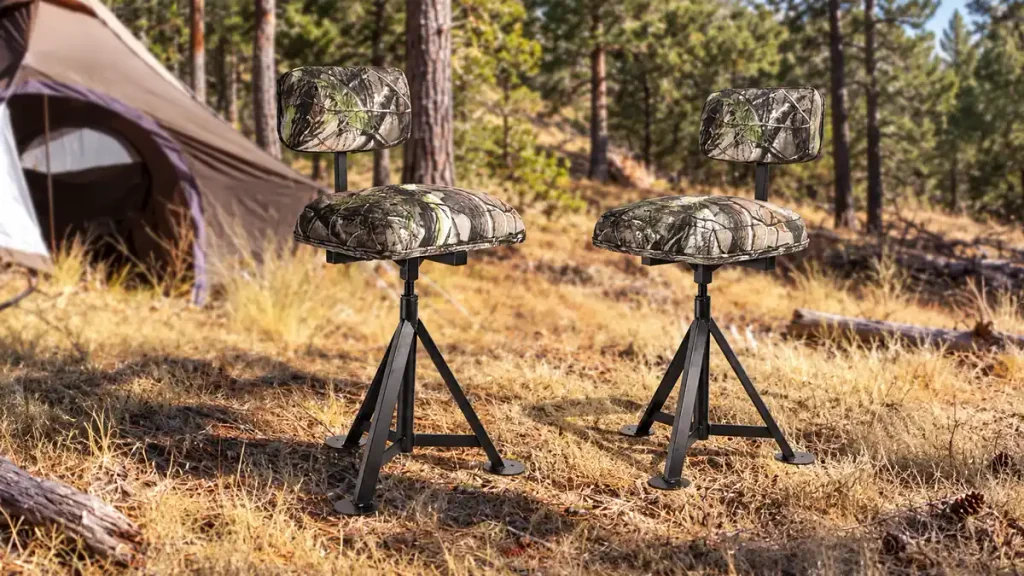
A hunting blind chair, also called a blind chair, is designed for sitting inside a blind. Check that the seat height fits the blind, then compare comfort, quiet movement, and stability.
Folding and Portable Designs
Folding and portability describe how a chair packs and carries, rather than a separate chair type. For a folding hunting chair or portable hunting chair, compare folded size, net weight, and the carrying method.
360° Swivel Designs
A hunting swivel chair lets users change direction while seated. For a 360° swivel hunting chair, check rotation smoothness, noise, and base stability.
Adjustable-Leg and Adjustable-Height Designs
An adjustable hunting chair may use adjustable legs for uneven ground or a seat-height setting. For an adjustable height hunting chair, confirm the height range, locking method, and foot contact.
Buyers should first choose the structure and functions needed for the actual use setting, then compare suppliers, specifications, and quotations on that basis.
What Makes a Hunting Chair Different from a General Camping Chair?
Some hunting chairs overlap with general camping chairs in portability and basic frame design, but hunting-specific models may add features for directional observation, uneven ground, and more specialized use.
- 360° Swivel Mechanism
- Adjustable Legs with Large Foot Pads
- Gun Rest
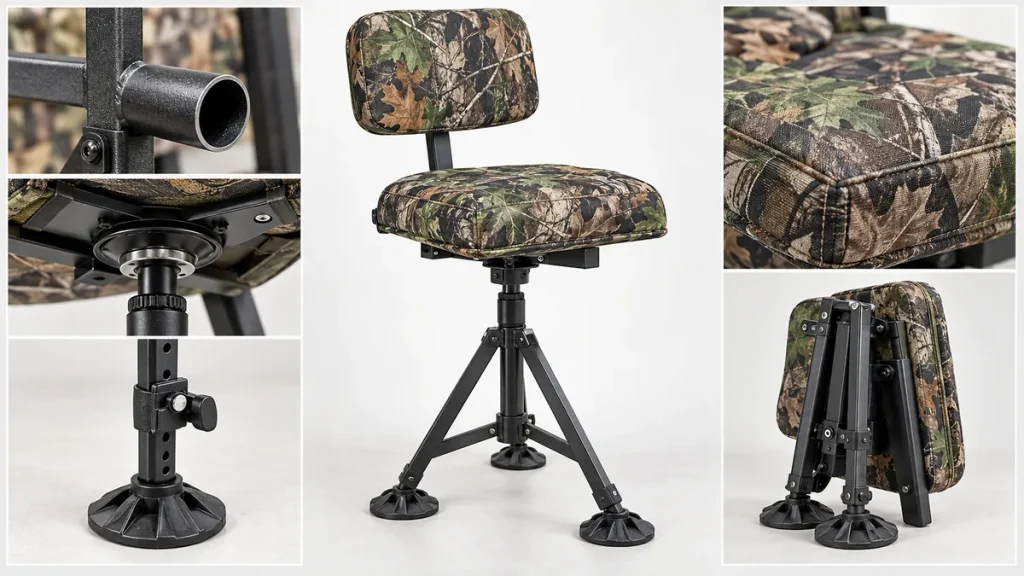
These are also key areas buyers should inspect carefully during sourcing and sample approval. Swivel models should be checked for smooth rotation, excessive play, and noise; adjustable-leg models should be checked for locking and ground contact; and gun-rest models should be checked for mounting stability. At the same time, a hunting chair should still maintain the portability expected from outdoor seating and camping furniture.
Key Specifications to Confirm Before Comparing Quotes
Before comparing hunting chair quotations, make sure suppliers are quoting against the same construction and specification. Chairs that look similar in photos can still differ in frame structure, weight, adjustment range, and packing size, which can directly affect cost.
Key points to confirm include:
- Seat size and height — Check seat width, seat depth, and backrest height. For a hunting blind chair, confirm that the seat height fits the blind.
- Frame and tube specification — Confirm material, tube diameter or section, wall thickness, and surface finish instead of relying on vague descriptions such as “heavy-duty.”
- Net weight, folded size, and packaging — For lightweight, folding, or portable hunting chairs, buyers should confirm the folded dimensions, carrying method, and carton dimensions.
For example, the ALPS OutdoorZ Stealth Hunter Deluxe (8433915) has a published product weight of 16 lb 9 oz (approximately 7.51 kg). Buyers should evaluate whether a hunting chair with similar specifications meets the needs of their target customers.
When checking carton dimensions, buyers should also confirm whether the measurements refer to individual packaging or a master carton containing multiple chairs. - Swivel mechanism and adjustment range — For a 360° swivel hunting chair, confirm rotation smoothness, noise, and play in the mechanism. For an adjustable height hunting chair or an adjustable-leg design, check the adjustment range, locking method, and foot design.
- Load capacity and test basis — The ALPS OutdoorZ Stealth Hunter Deluxe (8433915) has a manufacturer-stated weight capacity of 300 lb (approximately 136 kg). This published specification can serve as a reference for buyers when evaluating similar hunting chairs.
However, buyers should determine whether a product with a similar load capacity meets the needs of their target market and intended users. Purchasing decisions should not be based on the stated weight capacity alone. Buyers should also request relevant testing evidence from suppliers to verify the product’s strength, durability, and stability. - MOQ — Confirm MOQ for the exact model and configuration being quoted. Available stock, standard production, and customized orders may have different requirements; material purchasing batches and customization can also affect the minimum quantity.
Compare specifications first, then compare prices.
How to Evaluate Chinese Hunting Chair Suppliers
When screening suppliers of Chinese hunting chairs, buyers should look beyond product photos and platform descriptions. A more practical evaluation focuses on the supplier’s actual factory status, key product data, and sample or test evidence.
- Verify the company and factory — Confirm the legal company name, business license, actual factory address, and whether the supplier is a manufacturer or trading company.
- Request key specification data — Ask for measurable information such as product dimensions, net weight, tube size, wall thickness, materials, and packaging data.
- Review samples and test records — Check sample photos or videos, test SOPs, and test records, and make sure they match the model being quoted.
If possible, visit the factory in person. If this is not practical, a local sourcing agent can help verify the factory, production conditions, and whether the supplier information matches the actual operation.
Hunting Chair Accessories and Optional Features
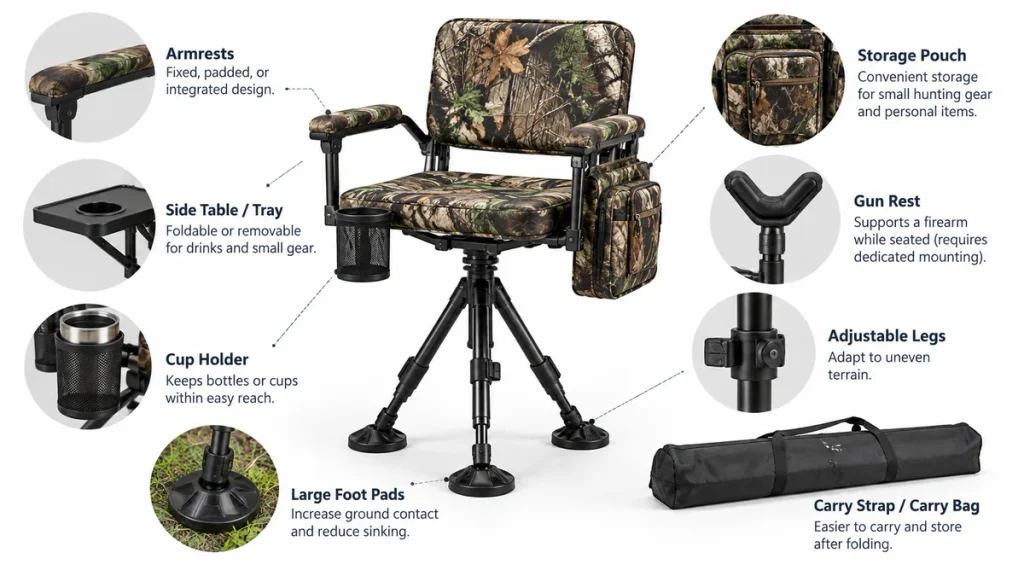
Hunting chairs can be configured with different accessories depending on the chair structure and intended use. Buyers should confirm which items are included as standard and which are optional before comparing quotations.
- Armrests — Improve comfort during longer periods of sitting and may be fixed, padded, or integrated into the frame.
- Side Table / Tray — Provides space for drinks, small gear, or personal items and may be foldable or removable.
- Storage Pouch — Adds convenient storage for small hunting gear and personal items.
- Cup Holder — Provides a dedicated place for bottles or cups, usually on the armrest or side of the chair.
- Carry Strap / Carry Bag — Makes the chair easier to carry and store after folding.
- Gun Rest — Supports a firearm while seated and usually requires a dedicated mounting structure.
- Large Foot Pads — Increase ground contact and help reduce sinking on soft or uneven ground.
- Adjustable Legs — Allow the chair to adapt better to uneven terrain.
The basic frame, seat, and required support structure are part of the standard product. Accessories such as armrests, side tables, storage pouches, cup holders, carry bags, gun rests, large foot pads, and adjustable legs may be standard on some models and optional on others. Buyers should ask suppliers to list standard configuration and optional accessories separately in the quotation.
Customization Options for Hunting Chairs
Buyers should define customization requirements based on the target market and actual use scenario, rather than treating customization as only a choice of color or logo. For example, products intended for wet, soft, or uneven ground may require different leg structures, foot pads, materials, or surface treatments than chairs used mainly on dry, firm ground.
| Customization Area | Options to Confirm |
|---|---|
| Frame and Structure | Fixed or swivel design, adjustable legs, armrests, gun rest, and foot structure |
| Fabric and Camouflage | Fabric type, mesh, padding, solid colors, camouflage patterns, and pattern authorization |
| Branding | Logo printing, woven labels, hangtags, carry bags, and retail packaging |
| Accessories | Storage pouch, cup holder, carry strap, gun rest, and other optional parts |
Buyers should first research and evaluate the target market and intended use scenarios, then decide which customization points are most important. If customization affects the frame, swivel mechanism, leg structure, or other load-bearing parts, the sample and relevant testing should be reconfirmed before mass production.
How Buyers Should Review a Hunting Chair Sample
From a buyer’s perspective, sample approval is not just about checking appearance. It is about verifying whether the supplier can actually deliver the agreed product and whether the sample can be used as a reference for mass production.
- Check against the confirmed specification — Compare seat size, seat height, net weight, folded size, materials, and other agreed data with the quotation or specification sheet.
- Verify key functions — Check folding, swivel movement, leg adjustment, locking, and other functions that affect normal use.
- Inspect load-bearing points — Pay attention to welds, rivets, bolts, hinges, frame joints, and reinforced sewing areas.
- Check key components — Confirm that the tube, fabric, swivel parts, foot pads, and accessories match what was agreed before sampling.
- Ask how the supplier tests the product — Request test methods, SOPs, photos, videos, or records where available, especially for load capacity and moving parts.
For a first-time supplier, buyers should personally inspect and actually use the sample after receiving it, rather than relying only on photos or videos. Go through the checklist, sit on the chair, fold and unfold it, rotate it if applicable, and test the adjustment and locking functions.
For suppliers with an established cooperation history, buyers may ask the factory to provide inspection records, photos, or short test videos instead of repeating every check personally, but the records should still match the approved specification and product model.
Compliance and Testing for Hunting Chairs
Compliance requirements should be determined by the target market, product structure, and intended user. Buyers should first confirm where the chair will be sold, who will use it, and whether it is a basic folding, swivel, or other specialized design before confirming the applicable regulations and test standards.
Before mass production, buyers can ask the supplier to provide the test method, test report, or actual test data, and verify that the model, structure, materials, and test conditions match the product being ordered. A stated load capacity alone should not be treated as proof of compliance.
Common Sourcing Risks
Even when hunting chairs look similar, several sourcing risks can affect quality, cost, and production consistency.
- Comparing by photos only — Similar-looking chairs may use different tube sizes, wall thicknesses, fabrics, swivel parts, or foot structures.
- Unverified load claims — A stated load capacity should not be accepted without understanding the test method and supporting data.
- Sample and mass-production differences — Tube specifications, fabric, swivel components, or other parts may change if they are not clearly controlled.
- Swivel looseness or noise — Swivel models should be checked for excessive play, noise, or sticking during sample approval.
- Unreliable adjustable legs — Locking mechanisms and foot pads should be checked carefully, especially for use on uneven ground.
For buyers, most of these risks can be reduced by confirming measurable specifications, testing the sample, and using the approved sample or confirmed specifications as the reference for mass production.
Conclusion
Sourcing hunting chairs from China starts with defining the product structure, target market, and actual use scenario, followed by confirming measurable specifications before comparing suppliers and quotations. Buyers should pay particular attention to swivel mechanisms, adjustable legs, load-test evidence, sample performance, and consistency between the approved sample and mass production.
If you are sourcing or developing hunting chairs in China, contact Jingtu Outdoor to discuss your target specifications, order quantity, customization requirements, and supplier options.
FAQ
What is the MOQ for hunting chairs from China?
There is no single MOQ that applies to all hunting chairs from China. Ask for the minimum quantity for the exact standard or customized model, including fabric color, logo process, hardware or structural changes, and the supplier’s material purchasing batches. For portable hunting chairs purchased wholesale, confirm folded dimensions and packing size alongside MOQ before comparing quotations.
What is the typical lead time for hunting chairs from China?
Confirm production lead time for the specific order after allowing for sample approval, material procurement, order quantity, factory scheduling, and customized packaging. Agree in writing when the production clock starts—for example, after sample and specification approval and the agreed deposit—and whether the quoted period ends at production completion or readiness for shipment. Keep sample approval time separate from production time.
What should buyers confirm about pricing and samples?
Before ordering, confirm the sample fee, sample lead time, quantity-based pricing, EXW or FOB terms, and packing data. Prices should only be compared after the product specifications and customization requirements are fixed.
What should buyers check before approving a sample?
Check dimensions, net weight, materials, swivel function, adjustable legs, locking points, frame connections, fabric, and sewing. For a first-time supplier, buyers should receive and actually use the sample instead of relying only on photos or videos.
How can buyers control quality during mass production?
Use the approved sample or confirmed specification as the production reference. Check whether the tube specification, wall thickness, fabric, swivel parts, foot pads, and accessories remain consistent, and spot-check swivel movement, adjustment, locking, workmanship, and packing.
What testing information should buyers ask for?
Ask the supplier for the test method, test report, or actual test data, especially for load capacity and moving parts. The model, structure, materials, and test conditions should match the product being ordered.
References
- ISO 7173:2023, Chairs and stools — Determination of strength and durability (Estonian Centre for Standardisation and Accreditation). Reference for structural strength and durability test methods; the applicable test plan should be confirmed for the actual chair design.
- Regulation (EU) 2023/988 on general product safety (EUR-Lex). Reference for EU market product safety obligations; it does not establish a hunting-chair-specific load rating.